
The 12 proven SEO writing tips to rank higher on Google are: match search intent, place keywords strategically, create a content outline, craft valuable content, structure for readability, optimize for AI search, use visual content, write descriptive alt text, optimize title tags and meta descriptions, clean up URLs, build internal links, and amplify with social media. The digital marketing world has moved beyond keyword stuffing and old SEO tricks.
Here’s what the data shows: SE Ranking’s 2025 analysis found that 94% of all web pages get zero traffic from Google. Only 1% get 11 or more clicks per month. This gap shows a major shift toward content that truly helps users find what they need.
The secret lies in mixing quality with optimization. Great SEO writing helps readers first, then shows search engines that value. This approach builds lasting traffic that survives algorithm changes.
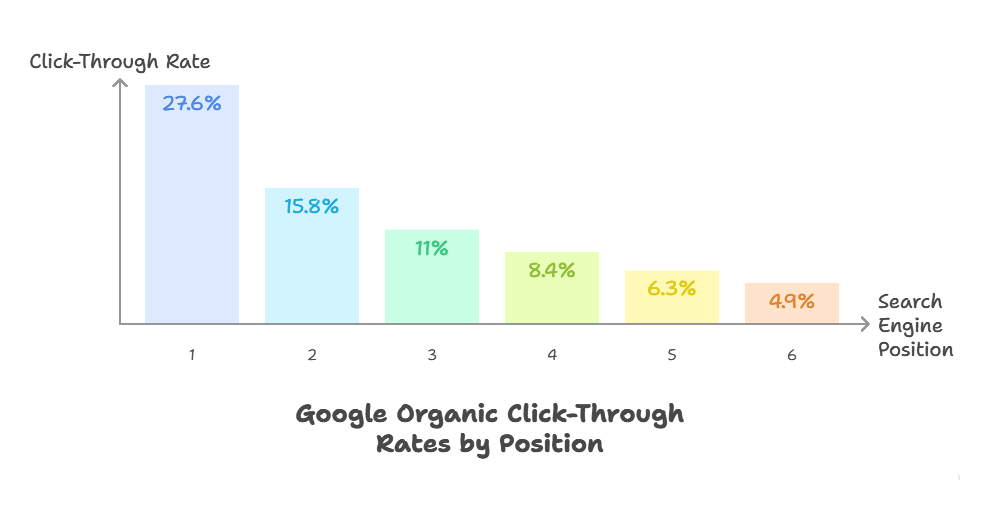
Top rankings matter. Position 1 gets nearly double the clicks of position 2
What You’ll Learn:
Here’s what you’ll find in this guide:
- Understanding search intent – What users want and how to deliver it
- Smart keyword use – Where to place keywords naturally
- Better content structure – Making content easy to read and rank
- Technical basics – Title tags, URLs, and meta descriptions
- Using visuals – Images and media that boost engagement
- Building links – Internal linking and social sharing tips
Reading time: 12 minutes
Tips for Writing SEO Optimised Content
SEO writing is about creating content that serves two goals: helping your readers and pleasing search engines. When you get this balance right, your expertise connects with people actively searching for your insights.
Here’s the shift: modern algorithms now reward helpful content over keyword-stuffed articles. Focus on answering real questions and solving real problems. Search engines will recognize that value and reward you for it.
1. Search Intent: What Users Really Want
Search intent is the foundation of good SEO writing. Google’s algorithms now match content to what users actually want, not just the keywords they type. Understanding this is critical for ranking success.
Most searches focus on learning, not buying. SE Ranking’s data shows that 70% of searchers want information, while only 1% are ready to buy immediately. The remaining searches were split between research (22%) and finding specific sites (7%). This breakdown reveals an important truth: your content should educate first and sell second.
There are four main types:
- Informational: Users want knowledge or answers
- Navigational: Users look for specific websites or pages
- Commercial: Users research products before buying
- Transactional: Users are ready to buy or convert
The best SEO writing addresses multiple types in one piece. Take an email marketing software article: it explains features for information seekers, compares products for researchers, and includes calls-to-action for ready buyers.
2. Keyword Placement: Where to Put Your Keywords
Smart keyword placement does two things: it helps search engines understand your content while keeping it readable for people. The key? Natural integration, not keyword stuffing.
Here are the best places to put keywords:
- Title tags and H1 headings for visibility
- Introduction paragraphs to set your topic early
- Subheadings (H2, H3) to structure your content
- Body content where it fits naturally
- Conclusion sections to wrap up your main points
The smart approach? Use keyword variations and related terms instead of repeating the exact same phrase over and over.
Focus on covering your topic well rather than hitting keyword percentages. Let natural language guide where you place keywords.
3. Create Outline: Plan Before You Write
Creating a detailed outline before writing helps you cover your topic fully while keeping a logical flow. Well-structured content performs better because it’s easier to scan, understand, and use.
Here’s how to build an effective outline:
- Research competing content to find gaps and opportunities
- Map user questions throughout their journey
- Organize topics from broad concepts to specific details
- Plan internal linking between related sections
- Identify where to add images and media

Use this template to plan your content before writing
Your outline also helps you plan keyword placement naturally. This way, your keywords appear in logical spots rather than feeling forced. It prevents awkward phrasing that happens when you add keywords to finished content.
Think of your outline as your content blueprint. The time you spend here pays off through every stage of writing and optimization.
4. Content Creation: Craft Valuable Content
Content creation for SEO means balancing detailed information with engaging writing. Your goal is to become the best resource on your topic while staying easy to understand.
High-performing SEO content has these key traits:
- Deep topic coverage, not surface-level overviews
- Original insights based on your experience
- Actionable advice readers can use right away
- Regular updates to stay accurate and current
- Clear value that stands out from competitors
AIOSEO research shows that content over 3,000 words gets three times more traffic and 77% more backlinks. This gives you a clear target for content that performs well.
Great content attracts backlinks, social shares, and return visitors. Search engines see these as quality signs and reward you with higher rankings.
5. Structure Content: Make It Easy to Read
Content structure is the foundation for both a great user experience and strong search performance. When content is well-structured, it guides readers through information easily while sending clear signals to search engines.
Essential structural elements include:
- Short paragraphs with white space for easy scanning
- Descriptive subheadings that preview each section
- Bullet points and numbered lists for complex information
- Strategic bolding to highlight key concepts
- Logical flow from general concepts to specific details
Heading and Subheading Hierarchy
The backbone of good content is a proper heading structure that both readers and search engines can navigate easily. The heading system (H1, H2, H3, etc.) creates a clear content outline that improves both accessibility and SEO performance.
DemandSage research shows that 59.5% of websites are missing H1 tags completely, while 51.3% have multiple H1 tags. Both practices confuse search engines and hurt SEO performance. This is a big opportunity for well-structured content to stand out.
Best practices for heading optimization include:
- Single H1 tag per page with your primary keyword
- H2 headings for main sections that support your topic
- H3 and H4 tags for subsections that go deeper
- Keywords in headings where they fit naturally
- Descriptive language that previews section content
Think of headings as navigation tools that serve two purposes. They guide readers through your content while giving search engines clear signals about your structure and topics. Each heading must do two things: keep readers interested and preview what comes next.
For SEO content, the inverted pyramid structure works best. Lead with your most valuable information, then add details in later sections. This creates a win-win: busy readers get immediate value while engaged users find complete information by reading more.
6. AI Search Optimization: Adapt to the Future of Search
AI search is changing how people find information online. Google AI Overviews, ChatGPT, Perplexity, and other AI tools now create answers directly instead of showing links. This shift means your content needs to work for both traditional search engines and AI systems.
The growth is clear: AI referrals to top websites spiked 357% year-over-year in June 2025, reaching 1.13 billion visits. AI search is now mainstream.
Here’s how to optimize for AI search:
- Structure content clearly with headers, short paragraphs, and bullet points
- Answer questions directly in the first paragraph under each heading
- Use statistics and data from authoritative sources
- Keep content fresh by updating stats, examples, and dates
- Write quotable snippets that are short, factual, and stand alone
AI search tools look for content they can trust and cite. Well-structured content makes it easier for AI to understand and pull clean snippets. Focus on making your content easy to parse, cite, and reference.
The key difference? Traditional SEO aims for rankings. AI search aims for citations and recommendations. When AI systems cite your content, you build authority even if users don’t click through immediately.
7. Visual Content: Use Images and Videos
Visual content improves both user engagement and SEO performance. It makes complex information easier to understand while increasing time on page, which search engines see as a quality signal.
DemandSage research shows that infographics are 30 times more likely to be read than text articles and can increase website traffic by up to 12%. This shows the real impact visuals can have on your content.
Here’s how to use visual content well:
- Custom graphics that illustrate key concepts
- Data visualizations that present statistics clearly
- Process diagrams that show how things work
- Screenshot tutorials that show specific techniques
- Branded imagery that builds your credibility
8. Alt Text: Make Images Accessible and Searchable
Alt text serves two purposes in modern SEO. It improves website accessibility for visually impaired users. It also helps search engines understand and index your images.
Here’s how to write good alt text:
- Describe images clearly and accurately
- Use keywords naturally where they fit
- Keep it concise while covering essential details
- Match the context of your surrounding content
- Write unique descriptions for each image
The best approach treats alt text as part of your content strategy, not just a technical requirement. This ensures your descriptions add real value while supporting your SEO goals.
9. Title Tags and Meta Descriptions: Your Search Result Ad
Title tags and meta descriptions work as ads for your content in search results. They directly influence whether users choose your page over competitors. These elements need careful work to balance keywords with compelling copy that drives clicks.
Backlinko’s research shows that page titles between 40 and 60 characters get an 8.9% better click-through rate. This gives you a clear target for optimal title length.
Here’s how to optimize title tags:
- Put primary keywords near the beginning when it feels natural
- Show the unique value that sets you apart from competitors
- Use compelling language that encourages clicks
- Stay within display limits to avoid getting cut off
- Keep brand consistency to build recognition and trust
Think of meta descriptions as your content’s elevator pitch. It’s your chance to highlight value while using relevant keywords. Write descriptions that make users want to click through to read your full content.
10. URLs: Keep Them Clean and Simple
URL structure impacts both user experience and search engine crawling. Clean, descriptive URLs provide clarity for both users and search engines about your page content.
Here’s how to optimize URLs:
- Include keywords in a natural format
- Use a logical hierarchy that reflects your site structure
- Separate words with hyphens, not underscores or spaces
- Use lowercase to avoid duplicate content issues
- Keep URLs brief while staying descriptive

SEO-Optimized URL Structure Example
Well-structured URLs also improve sharing. Users are more likely to share links that look professional and trustworthy. This sharing creates valuable social signals that support SEO performance.
11. Internal Linking: Build Authority and Guide Users
Internal linking helps your SEO in several ways. It spreads page authority across your website, helps search engines crawl your site, and guides users to more relevant content.
Internal links help search engines find new pages and understand how your content connects. This can boost rankings for linked pages.
Here’s how to use internal linking well:
- Link related content that connects topics
- Use clear anchor text that previews what’s linked
- Spread authority from strong pages to newer content
- Guide users through logical content paths
- Link important pages to give them more authority
The best internal linking feels natural and helpful, not forced. Each link should add value for readers while supporting your SEO goals.
12. Social Media: Amplify Your Content Reach
Social media helps your SEO in ways you might not expect. When people share your content, engage with your posts, and click through to your website, search engines notice. These signals show that your content has value.
Here’s how to use social media for SEO:
- Tailor content to each platform for better engagement
- Post when your audience is online to get more visibility
- Build real relationships with your community through genuine engagement
- Use eye-catching visuals that perform well in feeds
- Drive traffic back to your website through strategic linking
Social media won’t directly boost your rankings, but it supports SEO in powerful ways. Shares lead to backlinks. Engagement builds brand awareness. Traffic from social platforms sends positive signals to search engines.
The key is providing real value, not just promoting your content. When you help your audience solve problems and answer questions, they naturally engage and share. This creates the trust and visibility that support your long-term SEO goals.
Put It All Together
SEO writing success comes down to one thing: quality and optimization working together. These twelve strategies give you everything you need to create content that ranks well and helps your audience.
The key is consistency. Keep delivering value, stay strategic about how you present it, and your rankings will grow. Quality content doesn’t just survive algorithm updates—it thrives.
Start with one or two strategies from this guide. Implement them, measure what happens, and keep refining. That’s how you build lasting SEO success.
Frequently Asked Questions
How do I check if my content is optimized?
Use Google Search Console to track click-through rates, impressions, and rankings. Check page speed with Google PageSpeed Insights. Make sure your headings are structured correctly, and your meta descriptions are clear. Tools like Yoast SEO or SEMrush can help analyze keywords and readability.
What is the best SEO tool?
There’s no single best tool. SEMrush offers keyword research, competitor analysis, and content optimization. Google Search Console tracks performance. Ahrefs is great for backlinks. Pick the tool that fits your needs and budget.
Which is the best content format for improving SEO?
Long-form blog posts (2,000+ words) rank highest and get 3x more traffic than short content. But the best format depends on what users want. Use how-to guides for informational searches, comparison tables for research, and FAQ sections for quick answers.
How long does it take for SEO optimization to work?
It varies. New content usually ranks in 3-6 months. Technical fixes show results in 4-6 weeks. Competitive keywords take 6-12 months. Building authority needs consistent publishing for at least six months. Growth requires patience and consistency.
Can businesses survive without SEO?
Yes, through paid ads and social media. But they miss big opportunities. Organic search is the main traffic source for most websites. Skipping SEO means losing customers to competitors who invest in it.
Keep Learning About SEO
Continue reading these guides:
Claude AI for SEO: The Tool That’s Redefining Search Success
The Content Creator’s Dilemma: Claude vs ChatGPT in 2025
How to Unlock AI’s Potential with Prompt Engineering
Beginner’s Guide to Generative AI: Everything You Need to Know
Need Help With Your SEO Strategy?
Whether you’re building topic authority, optimizing for AI search, or improving technical performance, I can help. I create SEO strategies and content that drive real traffic and conversions for businesses like yours.
View My Services | Get in Touch

Curtis Haavi
SEO/AEO Specialist | Science & Technology
Curtis creates SEO content for AI, biotech, and tech companies. He combines molecular biology expertise with clear writing to produce content that ranks and engages.