
The best SEO practices in 2025 focus on three key areas: building real topical authority, ensuring technical excellence, and delivering authentic value to users. Digital marketing has entered a new era.
The data shows a big shift in how search works. Google’s March 2024 update removed 45% of low-quality content from search results. AI Overviews now appear in 19% of searches. Zero-click searches affect 60% of all queries.
What does this mean for you? You need to focus on three key areas. Build real topical authority. Ensure technical excellence. Deliver authentic value to users.
This guide walks you through the SEO practices that work in 2025. You’ll discover how to adapt to AI-enhanced search. You’ll also learn to create the strong technical foundation your site needs.
What You’ll Learn:
Here’s what you’ll find in this guide:
- How search engines evolved – AI features, answer engines, and new user behavior
- Creating better content – User intent and building topic authority
- Technical essentials – Mobile design, fast loading, and structured data
- Building quality links – Earning backlinks that help your rankings
- Winning at local search – Using Google Business Profile effectively
- Tracking your progress – The metrics that matter most
Reading time: 12 minutes
Evolution of Search Engines
The search landscape has changed more than at any time since Google launched. We’re now seeing answer engines and AI-powered features take over. The keyword-focused model that defined SEO for two decades is fading away.
Artificial Intelligence
AI has become the heart of modern search engines, changing how search engines read queries and judge content quality. Google now uses AI systems like BERT, MUM, and Gemini. These tools focus on understanding what users really want, not just matching keywords.
AI Overviews launched in May 2024. They now reach 1.5 billion users across 100 countries. They show up in 18.76% of US searches, with long-tail queries seeing them even more often. Searches with four or more words get AI Overviews 60.85% of the time.
AI systems now judge content quality differently by looking at how topics connect to each other. They check if your content covers a subject completely. This means you need to focus on deep topic coverage, not keyword density. AI rewards real expertise over simple optimization tricks.
Answer Engines
Traditional search engines sent users to websites with answers, but today’s answer engines give direct responses instead. This has changed user behavior and website traffic completely.
The numbers tell a clear story: 58.5% of US searches end without any clicks to external websites, while in the EU, that number hits 59.7%. Only 360 clicks per 1,000 US searches reach non-Google sites, with 2/3rds staying within Google’s network.
Featured snippets appear in 19-20% of searches and capture 8.6% of available clicks. People Also Ask boxes show up in 75% of searches. Your strategy should focus on visibility and authority, not just traffic numbers. Target featured snippets and create complete content that AI systems trust.
Zero-Click Searches
Zero-click searches have changed how users get information online, but smart marketers don’t see this as a threat. Instead, they use it to build brand authority and trust through search features.
Zero-click searches mainly affect informational queries where users want quick answers. Several key search features drive this behavior:
- Local packs provide direct business information, showing your address, phone number, and hours without requiring users to visit your website.
- Mobile searches make this trend stronger, with about 75% of mobile queries ending without clicks to non-Google properties.
Successful businesses create dual-purpose content that provides immediate value in search features while encouraging deeper engagement when users want more details.
On-Page SEO
On-page SEO work in 2025 has changed. It now goes beyond keyword placement and meta tags. Today’s best strategies focus on two things: creating great user experiences and building topic authority. You do this through complete content that shows real expertise.
User Intent
Understanding user intent is now a must for SEO success. Google checks how well your content meets the real reason behind searches.
User intent falls into four types:
- Informational (looking for answers)
- Navigational (finding a specific site)
- Transactional (ready to buy)
- Commercial (comparing options before buying)
Good content covers all these intent types within your topic area. Map user intent across your content and create resources that help users throughout their journey.
Voice search is growing. This means people now search the way they talk, not the way they type. Use natural language and question formats that match real conversations.
Content
Quality content has changed. Today, AI systems reward real expertise, unique insights, and value that readers can’t find elsewhere.
The data proves this works. Topic clusters generate 38% more organic traffic than traditional keyword structures. Building topic authority can boost visibility by up to 1,400%.
This approach works best:
- Create pillar pages for core topics
- Build cluster content for subtopics
- Use internal linking
- Connect related pieces
Google’s Knowledge Graph tracks 800 billion facts about 8 billion entities. Optimizing for entities is now essential for SEO success.
Topical Authority
The biggest SEO opportunity in 2025 isn’t chasing individual keywords. It’s becoming the go-to resource within specific subject areas. This earns trust from both users and search engines.
Here’s how to do it:
- Pick 3-5 core topics aligned with your business skills
- Create complete content covering all aspects of these topics
- Build clear links between related content
- Keep expanding your knowledge base within these areas
Content depth matters much more than breadth. Don’t create shallow content across hundreds of topics. Focus on becoming the best resource for fewer subjects. This aligns with how AI systems judge skill and helps build the lasting authority that drives long-term SEO success.
User Engagement
User engagement metrics now matter more for rankings. Search engines focus on content that truly meets the user’s needs. Longer session times, lower bounce rates, and higher click rates all signal quality.
Creating engaging content needs two things: knowing your audience and mixing good information with a great user experience. Videos, images, and good formatting help these metrics.
Check your data often to improve content. Track time on page, scroll depth, and link clicks to see how users interact with your content. Then make changes to improve user satisfaction and search performance.
Title Tags
Title tags remain crucial for rankings and click-through rates from search results. In 2025, effective title tags must do two things: add keywords for search engines and craft compelling copy that makes users click.
Best practices:
- Add primary keywords naturally within the title
- Keep titles under 60 characters for full visibility in search results
- Create unique titles for every page
- Write strong copy that sets your content apart from competitors
- Use power words like “essential,” “proven,” and “complete” to boost appeal
Check your title tag performance regularly to find ways to improve. Watch click rates from search results and adjust titles based on trends or new user interests in your topics.
Meta Descriptions
Think of meta descriptions as ads for your content in search results. While Google doesn’t use them for rankings, good meta descriptions drive higher click rates and better user response. Both help your SEO performance.
They should:
- Give strong summaries of page content
- Add relevant keywords naturally
- Include clear value statements
- Encourage action with subtle calls-to-action
Keep descriptions between 150-160 characters to prevent them from being cut off while getting your message across.
Create unique meta descriptions for every page to avoid duplication and let each page compete well in search results. Update descriptions regularly to keep them relevant and strong. This keeps click rates strong as your content grows.
Technical SEO
This is the base for all other SEO work. It’s no longer optional. It’s now essential for visibility, user experience, and staying competitive in search.
Mobile-First
Google completed its move to mobile-first indexing on July 5, 2024. Googlebot Smartphone now handles all crawling and indexing. Sites that don’t work on mobile get removed from search results completely.
Website platforms perform differently for speed and SEO. Squarespace sites pass Google’s speed tests 60% of the time. Wix manages 57%, Shopify hits 55%, while WordPress sites only succeed 40% of the time.
Focus on these mobile basics: optimize images for different screen sizes, make sure touch targets meet accessibility rules, and test how your site works across different devices.
Google changed its speed requirements in March 2024 to better match the real user experience. The system now tracks how quickly your website responds to every button press, form fill, and user action throughout their entire visit, not just the first click.
The numbers show room for growth. Sixty-seven percent of websites load quickly, but only 51% pass all Core Web Vitals requirements.
Page speed matters more than ever in 2025. Sites that load in under 2 seconds perform best. Sites taking more than 3 seconds lose 53% of visitors. Your technical work should focus on making your website faster and more responsive.
Key ways to speed up your site:
- Make important images load first
- Pre-load key resources for faster loading
- Hide content below the fold until needed
- Clean up your website’s code to reduce file sizes
- Aim for loading times under 2 seconds
Structured Data
Structured data helps your website stand out in search results with enhanced listings that show star ratings, prices, and other eye-catching details.
Real businesses see impressive results: Rotten Tomatoes achieved 25% higher click-through rates, Food Network saw 35% increased visits, and Rakuten experienced 1.5x longer user sessions.
Regular validation using Google’s structured data testing tools prevents common mistakes and ensures you get these opportunities.
Schema Markup
This helps search engines understand your content better. It acts as a bridge between what you write and how search engines read it. This boosts your visibility in AI-powered search features.
Priority schema types for 2025:
- Article schema for content pages
- Product schema for eCommerce
- LocalBusiness schema for local businesses
- FAQ schema for question-based content
- Review the schema for testimonials and feedback
You can also use advanced options like author schema for content creators, course schema for educational content, and event schema for time-based content. Schema markup helps search engines understand how people, places, and organizations in your content connect.
Backlinks
Link building in 2025 focuses on quality and natural growth over volume and tricks. Search engines can now spot fake link schemes easily. This makes real relationship building and good content the best approach.
What makes a good backlink:
- Relevance to your content and industry
- Authority of linking sites
- Placement within relevant content
- Natural anchor text variety
A single high-quality link often gives more value than dozens of low-quality links.
Focus on natural link growth by creating valuable resources that others want to share, building relationships in your industry, and sharing expert views on current topics. Check your backlinks often to find and fix bad links before they hurt your rankings.
Local SEO
Local SEO has grown far beyond basic directory listings. Success today needs three things: a strong Google Business Profile, local content, and community engagement. These work together to boost local visibility.
Google Business Profile got big updates in 2024-2025. The platform now offers AI responses, WhatsApp chat with customers, and AI backgrounds for product images.
The data is clear: 86% of profile views come from category searches, not brand searches. This makes proper setup crucial. A single review brings about 80 website visits, 63 requests for directions, and 16 phone calls. This shows the direct impact on business results.
What helps you rank locally:
- Business Profile category (most important)
- Reviews (81% happen on Google)
- NAP (Name, Address, Phone)
- Distance to the searcher
- Website content quality
- Accurate hours
- Popular times data
- AI Overview presence
Businesses with multiple locations need a clear plan: build unique pages for each site, set up separate Business Profile listings, and create content for each community.
Analysis
Measuring the right things helps you improve faster. Track performance data, user behavior patterns, content quality, and competitive gaps to guide your next moves.
Key metrics to track:
- AI Overview appearances
- Featured snippet wins
- Brand mentions
- Topic authority scores
- Time on site and pages visited
- Core Web Vitals scores
- Search feature wins
Run regular checks in four areas: technical, content quality, user experience, and competitors. Use Google Search Console, Google Analytics, and other tracking tools to see the full picture.
What to Avoid
Knowing what to avoid is as important as knowing what to do. Google’s systems and manual reviews penalize websites that use tricks or fail to meet quality standards.
Google now focuses heavily on scaled content abuse. This targets mass-produced content, whether AI or human-made, when created mainly for ranking gains. The March 2024 updates had big results: Google removed thousands of affiliate sites and AI content farms for breaking quality rules.
Avoid these in 2025:
- Mass-produced content for ranking
- Hosting low-quality third-party content
- AI content without human review
- Slow sites and mobile problems
- Keyword stuffing
- Buying low-quality links
- Duplicate and thin content
Here’s your prioritized action plan for 2025
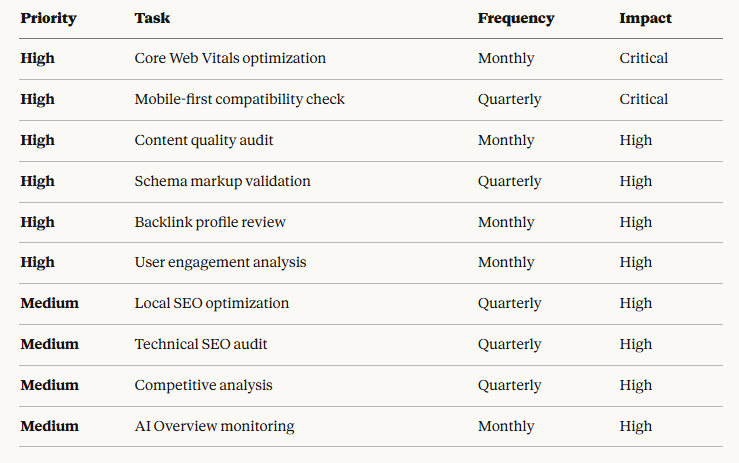
SEO tasks to focus on in 2025
Final Thoughts
The SEO world of 2025 rewards what it should have always rewarded: real expertise and genuine value for users. Tricks no longer work. Marketers face both challenges and opportunities as the industry shifts from keyword stuffing to AI-driven quality checks.
Success comes down to four things: build real topic authority, optimize for AI search, keep technical excellence, and always put users first. The businesses winning at SEO aren’t chasing shortcuts. They’re becoming the most helpful and trusted resources in their fields.
Search engines keep changing, but one truth stays: serve your audience well, and rankings will follow.
Frequently Asked Questions
What is the best practice for SEO in 2025?
Focus on three things: create quality content that helps users, make your site fast and mobile-friendly, and build real expertise in your topic area. Skip the tricks and focus on being genuinely helpful.
What is the future of SEO in 2025?
AI is taking over search. Google and other platforms now use AI to judge content quality and deliver instant answers through AI Overviews and answer engines. Your job is to create content that’s so good, AI systems want to reference it.
What is trending in searches in 2025?
Voice search, AI Overviews, and zero-click results. People want quick answers without clicking through to websites. About 60% of searches now end without any clicks. AI Overviews appear in nearly 20% of searches.
What are the 4 pillars of SEO?
The 4 pillars are: Technical SEO (site speed and structure), On-Page SEO (titles, meta descriptions, and page elements), Content (quality writing that helps users), and Off-Page SEO (backlinks and brand mentions from other sites).
What’s the biggest trend in 2025?
AI-powered search is the game-changer. AI Overviews show up in 19% of searches and reach over 1.5 billion users. Search engines now understand content meaning, not just keywords. This means you need to focus on creating helpful, authoritative content that AI systems trust.
Keep Learning About SEO in 2025
Continue reading these guides:
12 Proven SEO Writing Tips to Rank Higher on Google
Claude AI for SEO: The Tool That’s Redefining Search Success
How to Unlock AI’s Potential with Prompt Engineering
Beginner’s Guide to Generative AI: Everything You Need to Know
Need Help Implementing These SEO Practices?
Whether you’re building topic authority, optimizing for AI search, or improving technical performance, I can help. I create SEO strategies and content that drive real traffic and conversions for businesses like yours.
View My Services | Get in Touch

Curtis Haavi
SEO/AEO Specialist | Science & Technology
Curtis creates SEO content for AI, biotech, and tech companies. He combines molecular biology expertise with clear writing to produce content that ranks and engages.