
CRISPR-Cas9 is a gene-editing technology that allows scientists to precisely target and alter specific DNA sequences, with applications in curing genetic diseases, improving crops, and advancing drug discovery. CRISPR (Clustered Regularly Interspaced Short Palindromic Repeats) has revolutionized biotechnology.
Scientists discovered CRISPR as a bacterial defense system. Now, it’s a flexible tool changing medicine, agriculture, and research. Its ease of use has sparked global interest, making it a key part of modern science.
In this guide, we explore how this gene editing system works, its uses, and its potential to shape the future for anyone seeking to understand this major development.
What You’ll Learn:
This guide covers the key aspects of CRISPR-Cas9:
- What it is and how it has changed genetic engineering
- How the Cas9 system works
- Key uses in medicine, agriculture, and biotechnology
- Latest advances
- Current challenges in research
- Ethical concerns about human genome changes
Reading time: 10 minutes
How Does CRISPR-Cas9 Work?
CRISPR works like our immune system. When a virus infects us, we create an immune memory in the form of antibodies. Later, on reinfection, these antibodies quickly recognize and eliminate the invaders.
Similarly, when a virus infects a bacterial cell, CRISPR creates genetic memory. First, it inserts a fragment of the viral genome into the bacterial DNA. Then, from that acquired sequence, the system produces a guide RNA. This guide RNA directs the Cas nuclease to the matching viral DNA.
Subsequently, in the case of future infections, the guide RNA binds the invader’s DNA, and the nuclease destroys it.
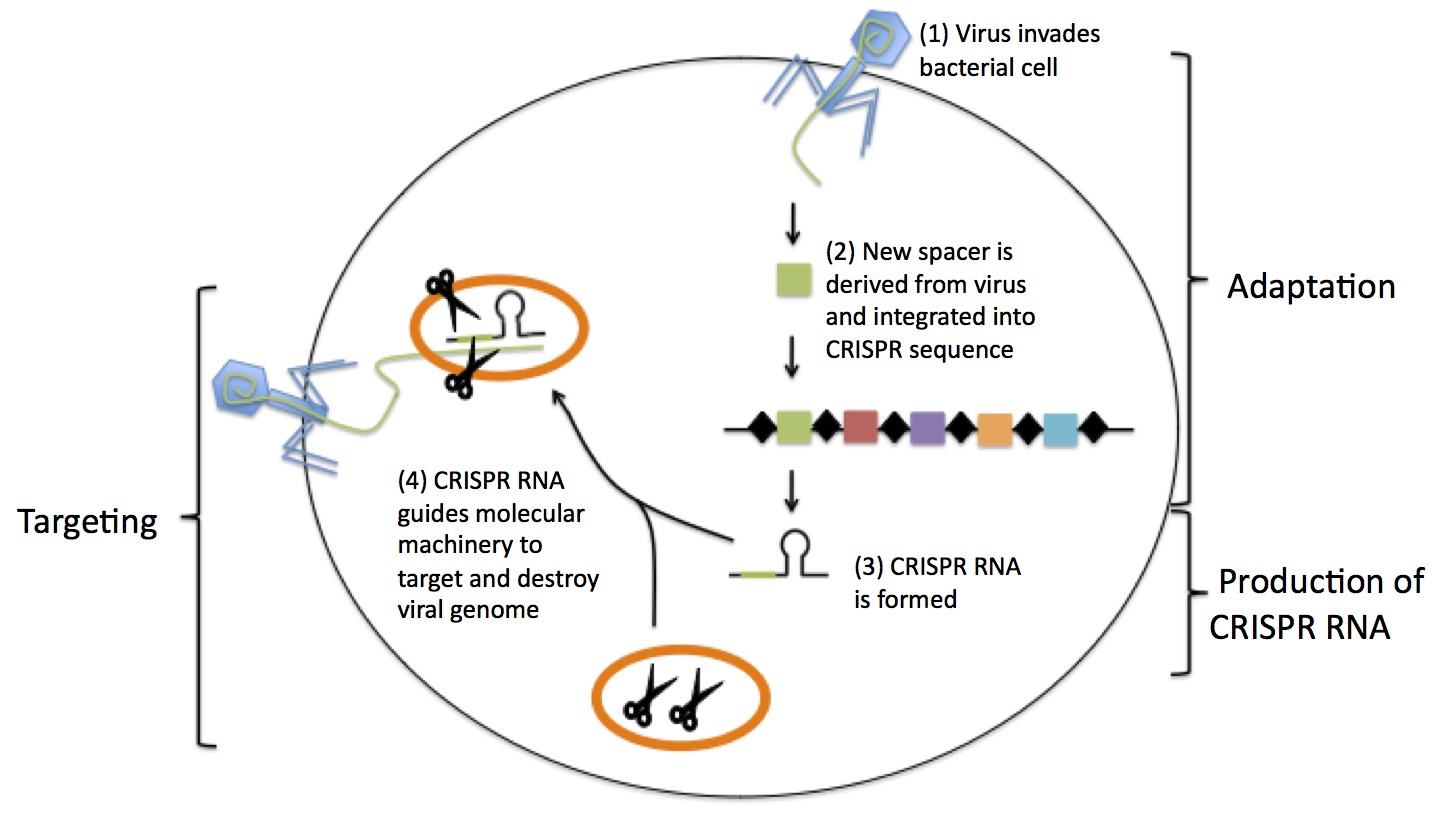
CRISPR-Cas9 works in three stages: it captures viral DNA, forms guide RNA, and destroys the invader.
Source: Nature
How CRISPR-Cas9 Edits Genes
In 2012, researchers discovered that they could engineer guide RNAs to direct a Cas nuclease, such as Cas9, to any specific DNA sequence. These engineered guide RNAs improve editing accuracy by ensuring cuts occur only at the intended genomic locus.
Once researchers cut the DNA, they can use the cell’s natural repair machinery to make precise genetic changes. CRISPR-Cas9 offers three main editing approaches:
1. Disrupt – Scientists inactivate a gene by introducing small errors during repair. Then, the cell repairs the cut through natural cellular processes, which can result in the addition or deletion of base pairs, leading to the inactivation of the gene.
2. Delete – Researchers remove a segment of DNA by using two guide RNAs that target separate ends. Subsequently, the cell joins the two separate ends together while removing the intervening sequence.
3. Correct or Insert – Scientists add a new sequence by providing a repair template with the desired DNA. Additionally, adding a genetic template alongside the CRISPR-Cas9 machinery can enable the cell to correct a gene or insert a new gene.
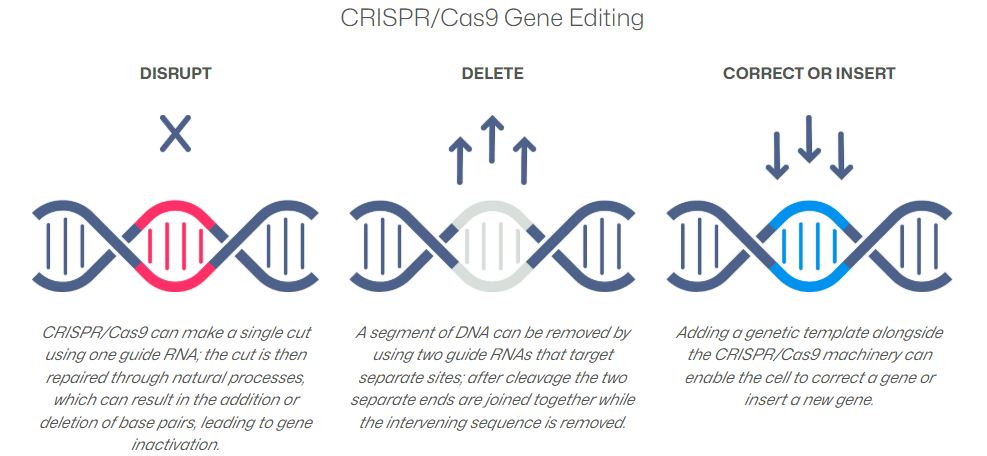
CRISPR-Cas9 can disrupt genes, delete DNA segments, or insert new sequences using targeted guide RNAs.
Source: NCBI
Key Applications and Latest Technologies
1. CRISPR Therapeutics
Casgevy for Sickle Cell Disease
December 2023 marked a major milestone in gene therapy. The FDA approved Casgevy as the first CRISPR-based therapy. It treats sickle cell disease and beta-thalassemia.
The therapy uses CRISPR/Cas9 to modify a patient’s blood stem cells. This allows them to produce more fetal hemoglobin and reduces symptom severity. As a result, the approval offers a potential cure for these inherited blood disorders.
World’s First Personalized CRISPR Therapy
Earlier this year, doctors at the Children’s Hospital of Philadelphia and Penn Medicine delivered the world’s first personalized CRISPR therapy to a baby named KJ. He was born with a rare disorder called severe CPS1 deficiency.
This disorder affects the urea cycle, a process that removes nitrogen waste from the body. The body can’t break down ammonia properly, causing toxic buildup in the blood. This leads to symptoms ranging from mild lethargy to severe brain problems and even death.
Doctors diagnosed KJ at birth. He spent his early months in the hospital on a strict diet before receiving his treatment in February 2025. The treatment targeted his specific genetic variant using base editing therapy delivered to the liver to correct his faulty enzyme.
The doctors delivered the treatment safely. Now, KJ is thriving and growing well. This shows that scientists can adapt gene editing technology to treat individuals with rare diseases that have no other treatments.
2. CRISPR in Drug-Target Discovery
CRISPR in Parkinson’s Disease
Over ten million people worldwide live with Parkinson’s disease (PD). It’s the second-most common brain disorder after Alzheimer’s disease. As a result, this has led to major investment in developing effective treatments.
In a recent study in the journal Science, researchers found a new set of genes linked to an increased risk for Parkinson’s disease. Therefore, this opens the door to new drug targets for treatment.
Research has found that the greatest risk factor for developing PD and dementia is carrying a pathogenic variant in the GBA1 gene. This gene is crucial for breaking down a specific type of fat molecule within lysosomes. The study used CRISPR interference to identify 16 proteins known as the Commander complex. Consequently, these proteins play a crucial role in lysosomal function, making them ideal targets for future drug trials.
3. Agricultural Improvements
Sorghum Enhancement
Sorghum is a dietary staple for millions of people in 30 countries across Africa and Asia. It provides food and fodder, primarily in traditional smallholder farming.
A recent study showed that CRISPR-Cas9 can enhance sorghum through targeted modifications to its genome. This allows precise gene editing to improve traits such as nutritional value, yield, pest resistance, disease resistance, and stress tolerance.
Additionally, scientists are using the technology to create new genetic variations and reshape existing sorghum varieties.
Potato Late-Blight Resistance
Potatoes rank as the third most vital food crop for human consumption, following rice and wheat. They serve as a dietary staple in Europe and parts of the Americas. However, similar to other vegetables, potatoes face numerous challenges that intensify due to climate change, impacting both crop yield and quality.
Late blight attacks the foliage and tubers of potatoes, causing them to rot. It occurs most commonly in warm, wet weather. The fungal-like pathogen Phytophthora infestans causes late blight. In this study, researchers used CRISPR/Cas9 to knock out susceptibility genes (S-genes). As a result, this led to higher yields under climate stress.
4. Bioenergy
Sugarcane for Bioethanol
Sugarcane is a promising feedstock for biofuel production, especially for ethanol. It has high sugar content and yield. Ethanol is crucial in energy production. It’s a renewable fuel source that can reduce our reliance on fossil fuels and cut greenhouse gas emissions.
CRISPR-Cas9 plays a key role in improving how sugarcane converts into biofuels. Scientists are developing sugarcane types with higher biomass, better breakdown, and more sugar. A recent study found that researchers can use it to reduce lignin in sugarcane. They target specific genes in the lignin pathway. This improves ethanol production.
Lignin makes biofuel production harder as it blocks access to sugars needed for fermentation.
Cassava Mutation Optimization
Cassava is a staple crop in many tropical regions. It’s not just a vital food source but also a key player in bioenergy. Farmers can convert their starch-rich tubers into ethanol. However, traditional breeding methods have limitations. The CRISPR/Cas9 system, while powerful, has faced challenges in achieving high mutation rates in cassava.
To combat these challenges, researchers at Guangxi University in China used a specific promoter to boost CRISPR/Cas9 editing in cassava. They achieved 95% mutation rates. Higher mutation rates mean more efficient gene editing. This can lead to cassava varieties with higher starch, disease resistance, and better adaptability. This improves its use as an ethanol feedstock.
Challenges
1. Limited Historical Data
CRISPR technology lacks long-term data to evaluate its safety and efficacy. Researchers need comprehensive data collection across diverse scenarios.
2. Persistent Uncertainties in Trials
Human trials have shown no off-target effects or immune responses. However, questions remain. Scientists must refine CRISPR’s accuracy and precision across varied human tissues and patient populations.
3. Beyond DNA Cutting
CRISPR is primarily a DNA-cutting tool. However, many genetic disorders result from abnormal gene regulation. In these cases, CRISPR should be used to regulate gene expression instead. Epigenetic editing tools offer a more precise solution.
4. Targeting Challenges
CRISPR’s success relies on the precise identification of its targets. For diseases like Alzheimer’s, causative genes are often unknown. Effective use demands exact knowledge of the target gene, cell type, and treatment timing. This may limit use to early life stages.
Ethical Concerns
1. Germline Editing
Editing the DNA of embryos, sperm, or eggs could result in heritable changes that affect future generations. This raises concerns about unforeseen consequences, such as new genetic disorders or imbalances in the human gene pool.
In 2015, Chinese scientist Huang and his team conducted an experiment that sparked global debate. Many experts called for suspending germline editing until researchers better understand its safety and ethical implications.
2. Eugenics and Designer Babies
The ability to select for traits like intelligence or physical abilities raises fears of eugenics. Such applications could widen social inequalities, as only wealthy individuals might have access to genetic enhancements. This would create a divide between the “genetically privileged” and others. The concept of “designer babies” raises moral questions about commodifying human life.
3. Informed Consent
Ensuring informed consent is challenging, especially for germline editing, where future generations cannot consent to changes. Patients or parents must fully understand the risks, which is difficult given the technology’s complexity and uncertainties.
4. Equitable Access
CRISPR therapies are expensive to develop and administer, raising accessibility concerns. If only wealthy individuals or nations can afford these treatments, existing health disparities could worsen, creating a genetic underclass.
5. Environmental and Agricultural Impacts
Beyond human applications, the use of CRISPR to modify plants, animals, or insects raises ecological concerns. For example, scientists use it to control mosquito populations. The affordability and efficiency of CRISPR could lead to the rapid deployment of genetically modified organisms (GMOs), potentially bypassing long-standing safety protocols.
Final Thoughts
CRISPR is at the forefront of scientific innovation, offering solutions to humanity’s most pressing challenges. This technology has shown its potential across medicine, agriculture, and biotechnology, from curing genetic diseases to improving crop resilience.
However, ethical and practical questions continue as the technology advances. The power to edit the human genome raises questions about access, consent, and long-term effects. We must balance innovation with responsibility.
Despite these challenges, the potential of CRISPR is clear. Researchers continue to improve the technology and develop new variants that push boundaries. The breakthroughs we’ve seen are just the beginning.
Understanding CRISPR becomes more important as this field continues to expand. Whether you’re a researcher, healthcare professional, or simply curious about biotechnology, staying informed about these developments matters.
Frequently Asked Questions
What is CRISPR-Cas9?
CRISPR-Cas9 is a gene-editing technology that allows scientists to target and modify specific DNA sequences within living cells. It uses a guide RNA and the Cas9 enzyme to make precise genetic changes.
How does CRISPR-Cas9 differ from other gene-editing technologies?
CRISPR-Cas9 is simpler, more cost-effective, and more efficient than previous technologies such as ZFNs and TALENs. This makes it more accessible for research and clinical applications.
Who invented CRISPR?
Emmanuelle Charpentier and Jennifer Doudna won the Nobel Prize in Chemistry in 2020 for their discovery of the CRISPR-Cas9 system. However, many other scientists have contributed to its development.
Is CRISPR ethical or unethical?
The ethical implications depend on its application. While it offers potential benefits for treating diseases, concerns like germline editing and equitable access require careful consideration.
Explore More Science & Tech Insights
Continue your learning with these essential guides:
The Future is Now: 10 Scientific Trends Reshaping Our World in 2025
Precision Medicine: The New Era of Personalised Healthcare
2025’s Breakthrough AI Trends: The 5 Innovations You Can’t Ignore
Need Science & Tech Content for Your Business?
Whether you’re looking to explain complex biotechnology, optimize your content strategy, or communicate breakthrough research, I can help. From gene editing to AI innovations, I create SEO-optimized content that educates and engages.
View My Services | Get in Touch

Curtis Haavi
SEO/AEO Specialist | Science & Technology
Curtis Haavi is an SEO content strategist specializing in AI, biotech, and emerging technologies. Combining molecular biology expertise with bioinformatics knowledge, Curtis helps research-driven companies create content that ranks and resonates.