
Generative AI refers to systems that create new content, such as text, images, music, and code, based on patterns learned from data. it’s now being used across healthcare, education, entertainment, and business. Artificial intelligence (AI) that writes articles, designs logos, creates code, and makes music, all from simple text instructions, isn’t science fiction anymore.
What You’ll Learn:
This guide covers everything you need to understand generative AI:
- What generative AI is and how it differs from traditional AI
- The technology and science behind AI content creation
- Real-world uses across industries, from healthcare to entertainment
- The benefits and limits of generative AI systems
- Key ethical concerns and responsible AI practices
- Practical steps for getting started with generative AI tools
Reading time: 12 minutes
What is Generative AI?
Generative AI refers to systems that create new content. We’re talking text, images, or music, all based on patterns learned from data. Here’s the key difference: traditional AI analyzes or sorts data. Generative AI actually makes something new.
Recent breakthroughs in this field have greatly changed several industries.
AI has been a hot topic for many over the last few years. The surge of interest really took off with ChatGPT’s release in 2022.
This sparked rapid growth in AI technologies. The result? AI became available to everyone, not just tech experts.
Here’s what the data shows. According to a 2025 study by McKinsey, AI investment has doubled in recent years. More organizations are adopting it as well. Currently, 78 percent of surveyed organizations use AI in at least one business function.
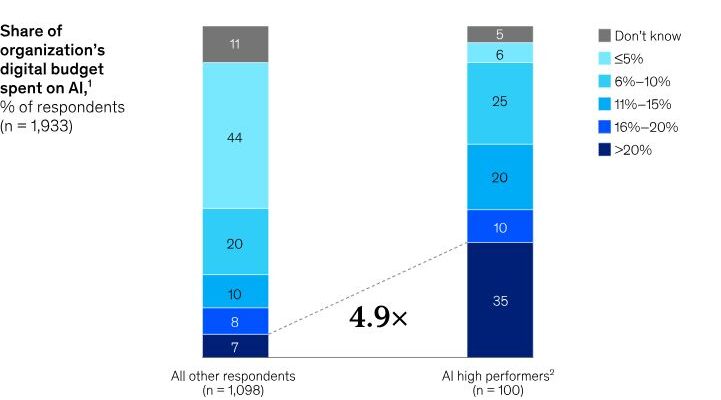
High-performing organizations spend over 20% of their digital budgets on AI. That’s 4.9 times more than the average respondent. This investment gap shows the growing importance of AI in gaining a competitive edge.
Source: McKinsey Global Survey, 2025
How Does Generative AI Work?
At its core, generative AI uses complex algorithms to copy human creativity. Think of it like this: deep learning models study how the human brain learns and makes decisions. Then they apply that same process.
Here’s how it works. The model finds patterns in large amounts of data. Then it uses those patterns to create something new.
This happens in five phases. Here’s how the process works:
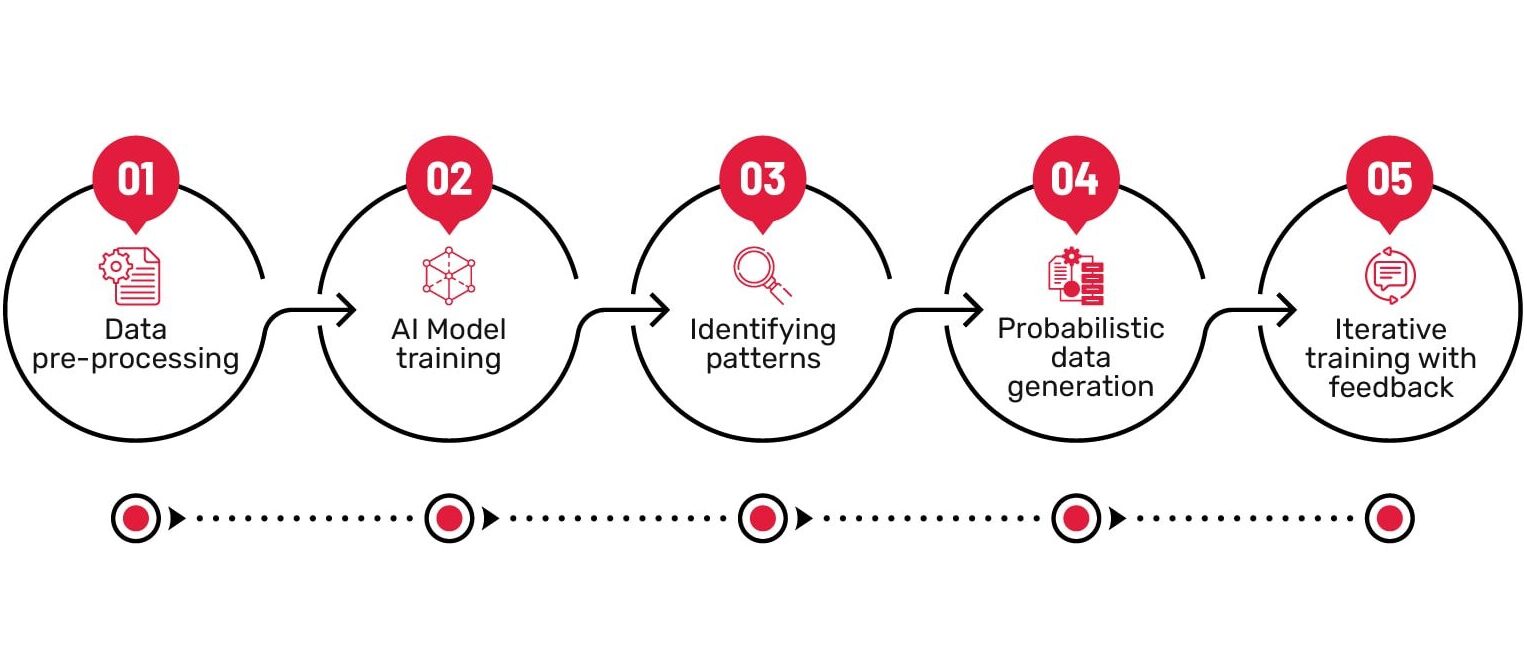
1. Data Pre-Processing
The process starts with collecting and preparing raw data. This means cleaning it, organizing it, and formatting it to ensure accuracy and consistency. The goal is simple: make sure it’s ready for training the AI model.
2. AI Model Training
The prepared data is used to train the AI model. During this phase, the model learns patterns, relationships, and structures in the dataset. This happens through deep learning algorithms.
3. Identifying Patterns
The trained model looks at the data to find patterns and connections. This step helps the AI understand the underlying structures. These structures will guide how it creates content.
4. Probabilistic Data Generation
Using the patterns it found, the AI creates new content. The model creates outputs based on how likely certain combinations are to occur. These combinations are similar to patterns in the training data
5. Iterative Training with Feedback
The created outputs get evaluated and fed back into the system. This continuous feedback loop makes the model more accurate. It also improves the quality of future creations.
Key Technologies Behind Generative AI
Generative AI relies on three core technologies, each serving a specific purpose:
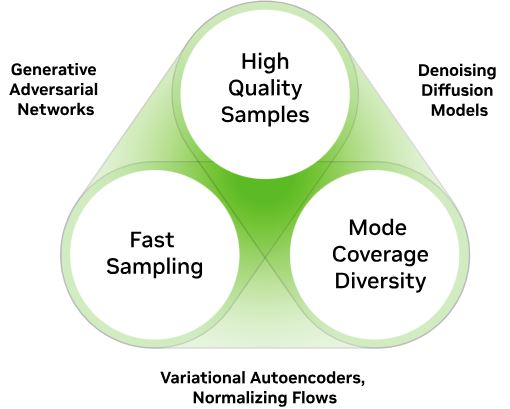
Generative AI relies on three core technologies. GANs produce high-quality samples. Diffusion models ensure diverse outputs. VAEs enable fast sampling for real-time uses.
Source: NVIDIA
1. Generative Adversarial Networks (GANs):
Think of this as a creative competition. Two AI models work together in this framework. One model creates content. The other critiques it. This back-and-forth produces high-quality samples across different domains.
2. Denoising Diffusion Models:
Here’s how these work. They start with random, noisy data. Then they gradually remove the noise to create clear content. They’re great at creating varied and realistic outputs. Popular tools using this include DALL-E and Stable Diffusion.
3. Variational Autoencoders (VAEs) and Normalizing Flows:
These techniques work in two steps. First, they compress data into a compact form. Then they rebuild it. This makes them fast, which is perfect for real-time uses. VAEs are especially useful for creating different versions of training data.
Applications of Generative AI
Don’t worry too much about the tech details! Here’s the key point: generative AI learns from large datasets to create outputs that look human-made.
Now let’s look at the different ways it’s used:
1. Content Creation
Text generation: Think of this as an AI writer. It uses machine learning models to create new text based on existing data. This can be blog posts, summaries, poetry, fiction, and social media posts.
Image generation: This is commonly used to boost existing data sets. It helps improve machine learning models. But it can also create art, illustrations, photo-realistic scenes, logos, and product markups.
Video and speech generation: Here’s how this works. Different deep learning models create new videos by making or editing short clips. They use a step-by-step “cleaning up” process.
The uses are pretty exciting. You can make short, eye-catching videos for social media quickly, animate still images, and turn scripts into video storyboards.
2. Multimedia Design
3D Modeling: This takes your input and creates a model that mixes different media types. We’re talking text, images, audio, and video, all combined to create engaging content.
The results can be shapes, textures, or entire scenes. Common uses? Gaming, architecture, and VR/AR experiences.
3. Educational Research
Personalized Tutoring: This greatly simplifies teaching. It creates customized lesson plans, explanations, and practice problems tailored to each student.
Scientific Writing: This helps researchers draft papers, summarize literature, and suggest hypotheses. It speeds up the research process.
4. Code Development
Schema markup generation: This creates the code used on the back end of a page. Why does this matter? It helps search engines give you the best results when you search.
Metadata generation: This creates descriptive labels or tags. These help systems and users understand, organize, and find content more easily.
Best Generative AI Tools
1. ChatGPT
This application from OpenAI mainly focuses on text generation. ChatGPT produces human-like responses in chat conversations. Due to its flexibility, it’s become a key tool in content creation, education, and coding.
The free version offers several features. However, if you want to take your content to the next level, the premium plans give you more advanced features.
2. DALL-E and MidJourney
These two tools focus on image generation. They can produce photo-realistic images through different models and techniques.
OpenAI created DALL-E. Here’s a tip: you can use ChatGPT to generate a prompt to get the best image results. Like ChatGPT, it’s free to use. However, you may need to check out the premium options based on your needs.
Midjourney offers similar services. But it’s not entirely free. They offer a free trial that lets you generate a limited number of images.
Want professional-grade content? Upgrading unlocks more capabilities.
3. Synthesia and DeepBrain
These tools use speech and video generation to create realistic video content. Synthesia lets you create high-quality videos without microphones, cameras, or actors.
It offers some free features but has its limits. Most users choose the subscription plans.
DeepBrain has a wide range of uses. These include video and image generation, video editing, and creating AI Avatars. Like Synthesia, it offers a free plan. However, you’ll need a paid subscription to access longer video content.
Choosing the Right Tool
Step 1: Define the Objective
Purpose: Identify what you want the AI tool to generate. Think text, images, music, or code.
Essential Features: List the must-have capabilities. These could be customization options, specific output formats, or integration with other tools.
End product: Determine whether your product is for personal use or more business-oriented.
Step 2: Set Your Budget
Decide how much you’re willing to invest. Options range from free tools to subscription services or one-time purchases.
Note: Premium tools might offer better quality, support, or advanced features.
Step 3: Check Hardware Requirements
Confirm that your hardware and software meet the tool’s specifications. We’re talking CPU, GPU, RAM, operating system, and dependencies.
Step 4: Quality Control
Review samples, demos, or trial versions. Check the realism, accuracy, or creativity of the tool’s output.
Make sure the results align with your quality standards and expectations.
Step 5: Review
Read user reviews, case studies, or expert opinions. These help you judge the tool’s reliability and performance.
Look for any known issues, limits, or common complaints that could affect your experience.
Benefits of Generative AI
1. Boosting Creativity
Generative AI excels at producing new ideas, designs, and even complete works of art. This makes it valuable for creative industries like advertising. Why? Fresh and innovative concepts are essential in these fields.
2. Enhancing Efficiency
Here’s one of the standout features: generative AI automates repetitive tasks. Think about creating reports, making multiple design variations, or handling routine content production. This technology saves you time and effort.
Fields like data analysis and graphic design benefit the most. Automation frees up professionals to focus on strategic or creative work.
3. Generating Synthetic Data
This is especially useful when real data is limited or sensitive. Here’s an example: in healthcare, it can produce artificial patient data to train machine learning models. This approach avoids privacy violations.
4. Enabling Personalization
Personalized experiences are increasingly in demand. Generative AI delivers by crafting tailored content that meets individual needs. We’re talking customized news articles and individualized product recommendations. The result? Better user engagement and satisfaction.
Industries like e-commerce and media can use this to build stronger connections with their audiences. This significantly improves customer experiences.
5. Aiding Problem-Solving
Generative AI can create multiple solutions to a single problem. This gives you a range of possibilities to explore and consider. It can brainstorm and evaluate different approaches. This helps you identify the most effective solution.
It becomes valuable for decision-making in complex scenarios. These range from business strategy to scientific research.
Challenges of Generative AI
1. Bias and Fairness
The outputs of generative AI can reflect biases in the training data. Here’s an example: if the data is skewed, the AI may produce content that reinforces stereotypes.
It may also discriminate against certain groups. This shows why we need better data curation and management.
2. Inaccurate Information
Here’s the problem: the deep learning models used in generative AI can produce outputs that lack solid backing or evidence. So while it can create new content, you must perform quality control.
This ensures the content is accurate.
3. Skill Gaps
Using generative AI effectively requires expertise in managing and interpreting its outputs. Remember this: the output the AI produces is only as strong as the prompt you create.
4. Resource Intensity
Training generative AI models requires massive amounts of computing power and data. We’re talking GANs or large language models here. This makes it tough for smaller organizations or individuals to adopt these technologies.
Why? Access to high-end hardware and diverse datasets is often limited.
5. Copyright and Ownership
Here’s where it gets tricky. When AI creates content that resembles existing works—like art, music, or writing—it raises questions about copyright and ownership. Current legal systems struggle to define ownership of AI-generated material.
This complicates accountability.
6. Deepfakes and Misinformation
Generative AI can create highly realistic yet fake content. Think deepfake videos or images. This poses a risk of misinformation, which can damage reputations and erode trust.
In recent times, cybercriminals have been using deepfakes to launch cyberattacks and financial fraud schemes.
Conclusion
Generative AI is an exciting technology that empowers anyone to create, innovate, and learn. It has several benefits and uses. But it’s important to understand its limits too.
Here’s the good news: by understanding the basics and experimenting with tools, you’ll be well-equipped in an AI-driven world.
Ready to put generative AI to work? Start with one of the tools mentioned in this guide and test it on a real project. For ongoing AI insights and discussions, connect with me on LinkedIn—I’d love to hear about your experience.
Frequently Asked Questions
What is the key feature of generative AI?
It can produce new data that looks like its training data.
Do I need coding skills to use generative AI?
No! Most tools are designed for non-technical users. They have simple interfaces.
What is no code?
It’s a software development approach. It lets non-technical users build apps and automate workflows without writing code.
Can AI replace humans?
Not quite. It’s a powerful tool. But human creativity and oversight are still essential.
What jobs will AI replace?
The effect of AI on jobs will vary. Some roles will be replaced quickly. Others will last longer.
Positions like data entry, scheduling, and customer service are most affected right now. AI is taking over these roles. It uses technologies like chatbots and robotic process automation.
What challenges does generative AI face with respect to data?
Data challenges include quality, privacy, bias, and transparency. These significantly impact how well generative AI works and how widely it’s adopted.
Explore More AI Insights
Continue your learning with these essential guides:
2025’s Breakthrough AI Trends: The 5 Innovations You Can’t Ignore
How to Unlock AI’s Potential with Prompt Engineering
The Content Creator’s Dilemma: Claude vs ChatGPT in 2025
Exploring Agentic AI: Capabilities, Applications, and Future Trends
Claude AI for SEO: The Tool That’s Redefining Search Success
Need AI & Science Content for Your Business?
Whether you’re looking to explain complex technologies, optimize your content strategy, or communicate breakthrough research, I can help. From AI trends to biotech innovations, I create SEO-optimized content that educates and engages.

Curtis Haavi
SEO/AEO Specialist | Science & Technology
Curtis Haavi is an SEO content strategist specializing in AI, biotech, and emerging technologies. Combining molecular biology expertise with bioinformatics knowledge, Curtis helps research-driven companies create content that ranks and resonates.