
Prompt engineering is the practice of designing clear, precise inputs to guide Artificial Intelligence (AI) models toward accurate and useful outputs, mastered through three core techniques: Zero-Shot, Few-Shot, and Chain-of-Thought prompting.
Imagine unlocking the full power of AI with just a few well-chosen words. This guide will walk you through a simple, proven framework. It transforms your ideas into accurate prompts so you can spend less time tweaking and more time creating.
What You’ll Learn:
This guide covers everything you need to master prompt engineering:
- What prompt engineering is and why it matters for better AI results
- Three proven techniques with real-world examples: Zero-Shot, Few-Shot, and Chain-of-Thought prompting
- A simple 7-step framework you can use right away
- Real examples from ChatGPT, DALL-E, and CodeGemma
- Common challenges and practical solutions
Reading time: 9 minutes
What is Prompt Engineering?
The practice of designing and refining the input (or “prompt”) you give to an AI model to get the most accurate, relevant, or creative output possible. It’s all about crafting clear instructions, questions, or context to guide the AI’s response in your desired direction.
This makes it a key technique in the field of generative AI. Generative AI refers to systems that create new content, such as text, images, or music, based on patterns learned from data.
Related: Beginner’s Guide to Generative AI: Everything You Need to Know
Prompting Techniques
1. Zero-Shot Prompting
The model performs tasks without using examples, relying on its pre-trained knowledge. This technique is great for quick, general tasks.
Examples:
- Translation:
Prompt: Translate “freedom” into French.
Output: Liberté.
- Summarization:
Prompt: Summarize the concept of quantum entanglement in one sentence.
Output: Quantum entanglement is a phenomenon where two or more particles become linked. The state of one instantly affects the other, no matter the distance.
- Question Answering:
Prompt: What is the capital of Brazil?
Output: Brasília.
2. Few-Shot Prompting
Requires a few examples (shots) of the desired task within the prompt to guide the model’s response. This helps the model understand the expected format or style.
Examples:
- Text Classification:
Prompt: Classify the sentiment as positive or negative: “This movie is fantastic!”
Output: Positive.
- Text Completion:
Prompt: Complete the analogy: “Big is to small as tall is to short. Fast is to slow as loud is to?”
Output: Quiet.
- Story Continuation:
Prompt: Continue the story: “She opened the door and saw a cat.”
Output: The cat meowed.
3. Chain-of-Thought Prompting
The user encourages the model to break down a problem step-by-step, improving its reasoning. This is especially useful for complex tasks such as math or logical questions.
Examples:
- Math Problem
Prompt: Solve 15 × 4. Explain your steps.
Output: To solve 15 × 4: Step 1: Break it into (10 + 5) × 4. Step 2: 10 × 4 = 40, 5 × 4 = 20. Step 3: 40 + 20 = 60. Answer: 60.
- Logical Reasoning:
Prompt: If all cats are mammals and some mammals are black, are some cats black? Explain.
Output: Step 1: All cats are mammals. Step 2: Some mammals are black. Step 3: Since cats are a subset of mammals, some cats may be black. Answer: Yes.
- Decision Making:
Prompt: Should I bring an umbrella if there’s a 40% chance of rain? Reason through it.
Output: Step 1: A 40% chance of rain means it’s fairly likely. Step 2: If it rains, an umbrella prevents discomfort. Step 3: If it doesn’t, carrying one is a minor issue. Answer: Bring it to be safe.
- Data Analysis
Prompt: Given sales of $100, $150, and $200 over three days, what’s the average? Explain.
Output: Step 1: Add sales: 100 + 150 + 200 = 450. Step 2: Divide by 3 days: 450 ÷ 3 = 150. Answer: $150.
Writing Prompts
With AI rapidly advancing across multiple industries, it’s essential to stay up-to-date on the latest techniques to remain competitive.
Here are some tips and tricks on how to get the best results using prompt engineering in generative AI:
Step 1. AI Persona
Provide the AI with context. This could be achieved by asking the model to adopt a specific persona or viewpoint. This is important as it will set the tone for the content you’re generating.
Example: As a math teacher, explain fractions to a 10-year-old.
Step 2. Objective
Be crystal clear about what you want to achieve. Are you seeking facts, creativity, or are you trying to solve a specific problem? A well-defined goal keeps your prompt focused and purposeful.
The best way to achieve this is to create an outline of what you want the model to do. This will lead to more accurate and consistent results.
Example: Summarize the key findings of the attached research paper.
Step 3. Target Market
Consider your audience and tailor your prompt towards those who will interact and benefit from the AI’s response.
Example: Write a product description for a new line of organic skincare products, targeting young adults concerned with sustainability
Step 4. Format
Once you have a clear goal, provide the AI with the needed instructions to generate the best output or format. For example, the user may want the model to break down the data into bullet points or a more visual format, such as a graph or table.
Example: Compose a 500-word essay discussing the impact of climate change on coastal communities.
Step 5. AI Model
Select a model that suits your task. Key factors to consider include the task type and model strengths. You may be looking to perform a creative task, such as creating a logo, or trying to produce more factual content, like an essay.
When considering the model’s strength, are you more interested in versatility or specialization? A rule of thumb is to start with a general-purpose model and adjust if needed.
Step 6. Put it Together
Consolidate everything into a single, cohesive prompt.
Step 7. Iteration
Test your prompt and refine it based on the feedback you receive from the output. Don’t be afraid to make changes; iteration is essential. Don’t settle for the first result you come across.
Examples of Prompts
1. Text Generation
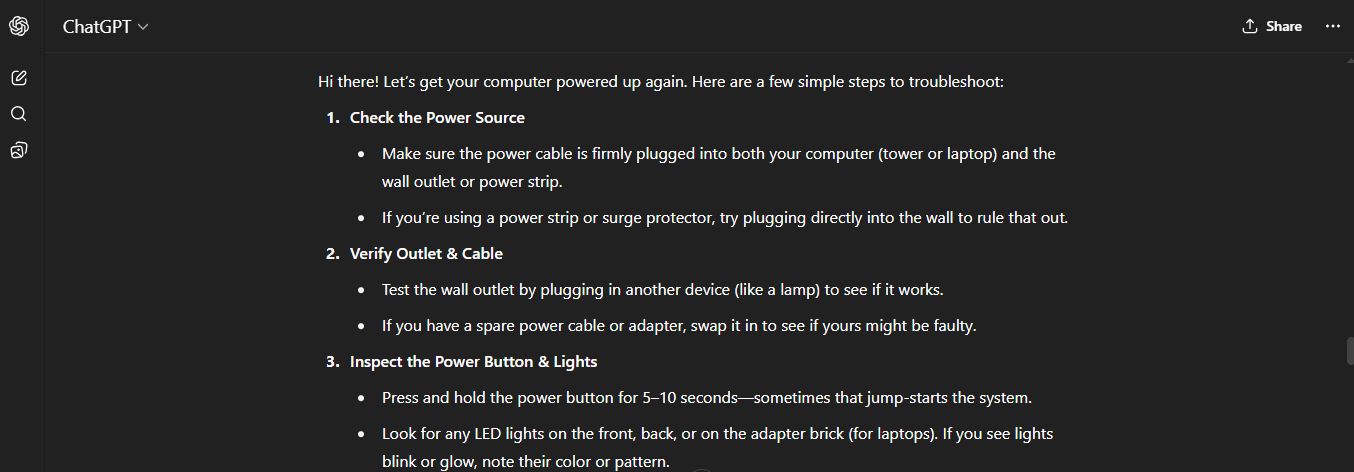
Example using OpenAI’s ChatGPT:
Prompt: You are a friendly chatbot helping users troubleshoot their computer problems. Respond to the user’s query: ‘My computer won’t turn on.’
Output:
2. Image Generation
Example using OpenAI’s DALL-E:
Prompt: Take on the role of a master artist from the Renaissance and create a photorealistic image of a sunset over the ocean with palm trees silhouetted against the sky.
Output:

3. Code Generation
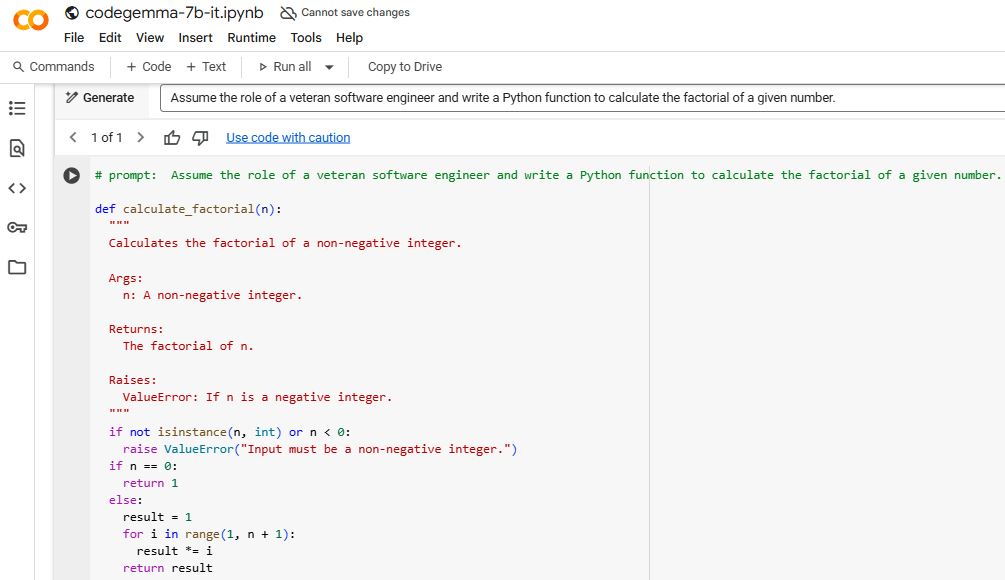
Example using Google’s DeepMind model, CodeGemma:
Prompt: Assume the role of a veteran software engineer and write a Python function to calculate the factorial of a given number.
Output:
Potential Challenges
1. Bias
Poorly designed prompts can accidentally trigger biases in the model. They may produce off-topic, harmful, or factually incorrect outputs.
Mitigating this requires careful prompt design and testing.
2. Ambiguity in Language
Natural language is naturally unclear. Crafting prompts that are clear and specific enough for an AI to interpret correctly can be difficult.
Small changes in wording can lead to vastly different outputs. This requires careful iteration.
3. Context Sensitivity
AI models rely heavily on the context provided in the prompt. Insufficient or overly complex context can result in responses that are either irrelevant or incomplete.
Balancing the right amount of context without overwhelming the model is a challenge.
4. Model Limits
Even advanced models have limitations in understanding nuanced instructions or handling specific tasks. For example, they may struggle with complex reasoning or highly domain-specific knowledge.
Prompts must be tailored to work within these constraints.
5. Experimentation
Prompt engineering often involves iterative experimentation to find the most effective phrasing, structure, or examples.
This can be time-consuming and lacks standardized methods.
Master Prompt Engineering Today
Prompt engineering is both an art and a science, blending creativity, technical precision, and an understanding of AI capabilities. By crafting effective prompts, you can unlock the full potential of AI models to solve problems, create content, and drive innovation.
As AI models evolve, prompt engineering will play an increasingly vital role in unlocking their capabilities. Advances in natural language processing (NLP) and the growing use of AI in industries like healthcare, finance, and education will drive demand for skilled prompt engineers.
The growth of automated prompt optimization tools and standardized frameworks will make prompt engineering more accessible to non-experts.
For businesses, mastering prompt engineering can lead to more efficient workflows, personalized customer experiences, and innovative solutions. For individuals, it’s a valuable skill to stay competitive in an AI-driven world.
Whether you’re a marketer, developer, or business owner, learning prompt engineering can give you a competitive edge in today’s AI-powered landscape.
Ready to put this into practice? Choose one AI tool you use regularly and rewrite your next prompt using the 7-step framework. Watch how much better your results become.
Frequently Asked Questions
What is the role of a prompt engineer?
A prompt engineer designs, tests, and refines prompts to optimize the performance of generative AI models.
Can anyone learn prompt engineering?
Yes, with the correct skill set, anyone can learn prompt engineering.
What is the significance of prompt engineering in generative AI?
It directly impacts the quality and relevance of the AI’s output.
What are the three types of prompt engineering?
The three main types of prompt engineering are Zero-Shot, Few-Shot, and Chain-of-Thought prompting.
What is an example of using roles in prompt engineering?
Here is an example: You are a veteran software engineering instructor. Explain the concept of recursion to a beginner in simple terms with a real-world analogy.
Want to Master AI?
Continue your learning journey with these guides:
Beginner’s Guide to Generative AI: Everything You Need to Know
2025’s Breakthrough AI Trends: The 5 Innovations You Can’t Ignore
The Content Creator’s Dilemma: Claude vs ChatGPT in 2025
Claude AI for SEO: The Tool That’s Redefining Search Success
12 Proven SEO Writing Tips to Rank Higher on Google
Looking for AI content expertise? Get in touch.

Curtis Haavi
SEO/AEO Specialist | Science & Technology
Curtis Haavi is an SEO content strategist specializing in AI, biotech, and emerging technologies. Combining molecular biology expertise with bioinformatics knowledge, Curtis helps research-driven companies create content that ranks and resonates.
Connect on LinkedIn | Email: connect@curtishaavi.com