
What is Agentic AI?
Agentic AI is a type of artificial intelligence that can set its own goals, make decisions, and complete tasks independently without constant human supervision. Think of it as a new wave of smart technology that’s reshaping industries, healthcare, daily workflows, and beyond.
So what can these agents do? They look at data and figure out what matters. They set their own goals based on what needs to happen. And here’s the exciting part: they get work done with very little help from humans.
But there’s more to the story. These agents make decisions just like you would when solving a problem. They handle challenges the moment they pop up. Plus, they learn from experience and keep getting smarter over time.
What You’ll Learn:
This guide explores how Agentic AI is transforming industries worldwide:
- What Agentic AI is – Core capabilities and key differences from traditional AI
- How it works – The four-step process behind autonomous decision-making
- Types of AI agents – From simple reflex systems to advanced learning agents
- Real-world innovations – Breakthrough applications in surgery, robotics, and automation
- Getting started – Practical steps to implement Agentic AI in your projects
Reading time: 11 minutes
Agentic AI vs Generative AI
Gen AI
Generative AI works like a creative powerhouse. It produces original content such as text, images, music, or code from scratch. This technology shines when you need fresh ideas, compelling stories, or innovative solutions. However, it needs you to point it in the right direction. You define the goals and provide the context. Essentially, Gen AI focuses on creating content rather than taking action.
Related: Beginner’s Guide to Generative AI: Everything You Need to Know
Agentic AI
Now here’s where things get interesting. Agentic AI powers systems that actually run themselves. These systems make decisions, create plans, and carry out tasks without constant human supervision. They analyze situations as they unfold, adapt to unexpected changes, and learn from each experience to hit specific targets.
Key Differences
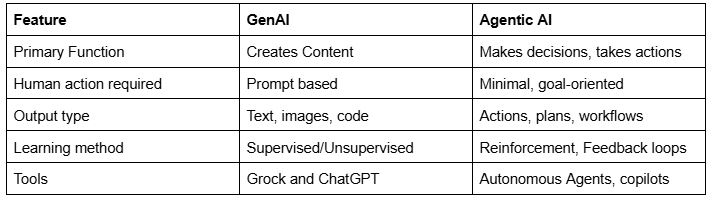
GenAI creates content while Agentic AI makes decisions and takes action
Combined Potential
When you pair these two technologies, something powerful happens. Picture this: GenAI designs eye-catching marketing materials with creative flair. Meanwhile, Agentic AI takes those materials and distributes them strategically across platforms. It uses live data and campaign targets to decide where and when to post. This partnership blends creativity with smart automation, creating results that neither technology could achieve alone.
How Does it Work?
Agentic AI follows a four-step approach to solve problems:
1. Perceive
The AI gathers and reads data from sources like sensors, databases, and online platforms. It spots key details and understands what’s happening around it.
2. Reason
A large language model acts as the brain, looking at tasks and planning strategies. It directs specialized models that handle specific jobs like writing text, reading images, or suggesting options.
3. Act
The AI links to outside tools and software through APIs, putting plans into motion quickly. You can build in safety checks too. For example, a customer service AI might solve small claims on its own but send larger ones to you for review.
4. Learn
The AI uses feedback from each interaction to improve its models. This means decisions and performance get better with every experience.
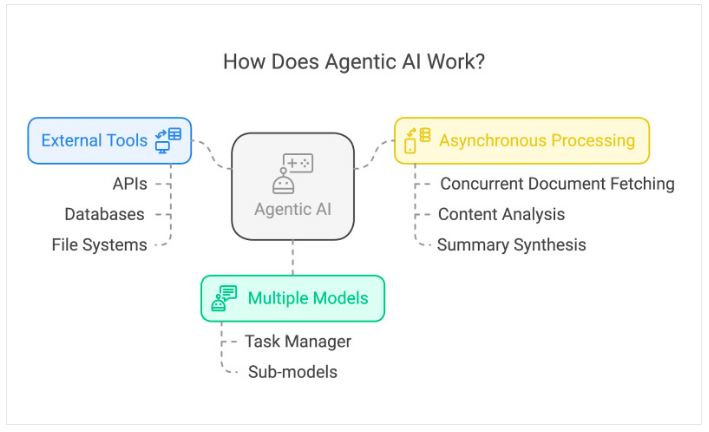
Agentic AI connects tools, runs multiple models, and handles tasks at once
Source: DataCamp
Types of AI Agents
There are five main types of AI agents:
Simple Reflex Agents
How They Work: These agents react to what’s happening right now using basic rules. They follow a simple pattern: if they see X, they do Y. They don’t remember the past or plan ahead—they just respond to the current situation.
Example: A thermostat controls your heating system. When the temperature drops below your set point, it turns the heater on. It doesn’t track yesterday’s temperature or predict tomorrow’s weather.
Model-Based Reflex Agents
How They Work: These agents keep a mental picture of their world, which helps when they can’t see everything directly. They use this picture to guess what’s happening and then pick an action. This makes them more flexible than simple reflex agents.
Example: A self-driving car uses sensors to detect nearby vehicles and road conditions. It builds a picture of what might happen next, like predicting if the car ahead might brake. Based on this, it decides to slow down or change lanes.
Goal-Based Agents
How They Work: These agents aim to reach specific targets. They think about what might happen if they take different actions and choose the one that gets them closer to their goal. This often means planning ahead and comparing options.
Example: A chess-playing AI wants to checkmate its opponent. It looks at possible moves, predicts outcomes several steps ahead, and picks the move most likely to lead to victory.
Utility-Based Agents
How They Work: These agents don’t just reach goals—they try to get the best possible outcome. They weigh different options based on reward, cost, and risk, then choose the action with the highest value. This works well for complex decisions.
Example: A stock trading AI aims to maximize profit while managing risk. It looks at various investments and picks the one offering the best balance between potential returns and stability.
Learning Agents
How They Work: These agents get better over time by learning from experience. They have a learning system that updates their knowledge based on feedback, allowing them to adapt to new or changing situations.
Example: A movie recommendation system watches what you rate, click, and buy. It learns your tastes over time and suggests content that matches your preferences better with each interaction.
Multi-Agent Systems
Multi-Agent Systems (MAS) bring together multiple independent AI agents that interact with each other and their environment. Each agent makes its own decisions based on what it sees and knows, but they often work together, compete, or coordinate to solve tough problems. You’ll find MAS in robotics, traffic management, and online marketplaces where distributed problem-solving matters.
Latest Tech Innovations
1. AI Surgeon Performs Gallbladder Removals With 100% Success
Researchers at Johns Hopkins University just achieved something remarkable. An AI-powered surgical robot removed gallbladders on its own with zero human help and succeeded every single time.
The team upgraded the Da Vinci research kit, a widely used robotics surgery system, with a machine learning model. This created a new platform called the Surgical Robot Transformer Hierarchy (SRT-H). Unlike older systems that followed strict instructions or needed humans guiding the arms, this one learned by watching video footage of real gallbladder surgeries.
Researchers tested it on advanced human-like models with synthetic organs. The robot completed 17 individual tasks across 8 different surgeries with a 100% success rate. It didn’t just copy motions—it fully executed the procedures on its own. The researchers believe that with more training, it could handle a wider range of surgeries and operate on real patients with minimal supervision.
2. Humanoid Robots Play Autonomous Football in Beijing Tournament
In Beijing’s Yizhuang zone, four teams of Booster humanoids played China’s first football robot tournament without any remote control. These machines tracked teammates, read field lines, and decided when to pass or shoot based on real-time situations.
Cheng Zhao, CEO of Booster Robotics, sees potential for mixed human-robot matches but emphasizes safety first. This development sounds less like science fiction and more like something you’ll see on next year’s calendar.
3. Amazon Deploys One Million Robots Powered by DeepFleet AI
Amazon recently hit a major milestone by deploying its one millionth production robot in a fulfillment center in Japan. Robots now work nearly one-to-one with human employees across more than three hundred facilities.
The entire fleet runs on Amazon’s latest generative AI model, DeepFleet. This technology coordinates robot movement across the fulfillment network, cutting travel time by 10%. The result? Customers get packages faster at lower costs.
4. Ai-Da Paints King Charles and Redefines Robot-Made Art
Ai-Da, the ultra-realistic humanoid, just unveiled an oil portrait of King Charles called “Algorithm King.” The piece honors the monarch’s work on environmental conservation and interfaith dialogue.
Aiden Meller built Ai-Da in 2019 with AI researchers from the University of Oxford and Birmingham. Their goal was to create original works that spark debates and widen conversations rather than push existing artists out of the industry.
Challenges
1. Balancing Autonomy and Oversight
Agentic AI’s independence brings major benefits, but giving machines decision-making power needs careful thought. Finding the right balance between AI freedom and human supervision prevents unwanted outcomes and ensures actions follow ethical and legal standards.
2. Promoting Transparency and Trust
The way agentic AI makes decisions can be hard to understand. Users and stakeholders often struggle to see how or why the AI reached certain conclusions. This lack of clarity hurts confidence and raises questions about fairness and reliability.
3. Safeguarding Security and Privacy
Connecting agentic AI to business systems that handle sensitive data creates real security concerns. As these systems become more connected and independent, the risk of data breaches and cyber threats grows. Strong protective measures are essential.
How to Get Started
Step 1: Build a Strong Foundation
Start by learning the basics of AI. Focus on machine learning, large language models, and automation. These ideas form the building blocks of Agentic AI.
Step 2: Stay Updated on Industry Trends
Follow the latest developments in Agentic AI. Join online communities like AI forums, AI Nexus, or LinkedIn groups. These spaces let you connect with experts and learn from their real-world experiences.
Step 3: Experiment with Hands-On Projects
Build small projects to see how Agentic AI works. Try creating a simple task automation agent. Use platforms like TensorFlow or PyTorch to get started. For robotics projects, try open-source tools like ROS.
Step 4: Monitor and Improve Continuously
Keep your AI systems updated and secure. Track performance using feedback loops and user insights. Look for ways to improve. This helps your system adapt to new situations and stay effective.
The Future of Agentic AI
The future of Agentic AI is here, and it’s happening faster than you might think. This technology is moving from labs into real businesses, changing how we work in healthcare, finance, customer service, and software development.
Here’s what’s coming. By 2028, experts predict that 33% of enterprise software will include Agentic AI. That means smarter tools that handle routine work while you focus on strategy. For businesses, this translates to automation that actually thinks and adapts. For you as an individual, it means AI assistants that understand context and get things done without constant prompting.
But here’s the reality check. We need to solve some big challenges first. Data privacy can’t be an afterthought. Ethical guidelines need to keep pace with innovation. And we must address bias in AI systems before they scale.
So where does this leave you? Agentic AI isn’t just another tech buzzword—it’s a fundamental shift in how intelligent systems work with us. The question isn’t whether this technology will reshape industries. It’s whether you’ll be ready when it does.
Start exploring Agentic AI today. Experiment with the tools, join the conversations, and build your understanding now. The organizations and professionals who grasp this technology early will have a massive advantage. Don’t wait until everyone else catches up.
Frequently Asked Questions
Will AI replace humans?
No. AI handles data processing, pattern recognition, and repetitive tasks well. But it can’t match human creativity, emotional intelligence, or complex judgment calls.
Which AI is the best?
It depends on what you need. Different AI systems work better for different tasks.
Is ChatGPT an agentic AI?
No. ChatGPT creates content based on your prompts, but it can’t set its own goals or act independently. It waits for you to tell it what to do.
Is agentic AI the next big thing?
Yes. Experts see it as a major breakthrough because it can automate complex workflows and make decisions on its own.
What problems can agentic AI solve?
It automates complex tasks, personalizes experiences, and makes proactive decisions across industries like healthcare, finance, and customer service.
How does agentic AI make decisions?
It follows four steps: perceive (gathering data), reason (planning with a language model), act (executing through tools and APIs), and learn (improving from feedback). Each cycle makes the system smarter than the last.
Keep Exploring AI Innovation
Continue expanding your knowledge with these guides:
2025’s Breakthrough AI Trends: The 5 Innovations You Can’t Ignore
Beginner’s Guide to Generative AI: Everything You Need to Know
Claude AI for SEO: The Tool That’s Redefining Search Success
The Future of Robotics: 10 Revolutionary Trends Reshaping 2025
How to Unlock AI’s Potential with Prompt Engineering
Need Expert Content for Your AI or Biotech Brand?
Whether you’re launching an AI product, explaining complex technology, or building thought leadership, I create content that connects with technical audiences. From in-depth guides to SEO-optimized articles, I turn emerging tech into clear, compelling narratives.
View My Services | Get in Touch

Curtis Haavi
SEO/AEO Specialist | Science & Technology
Curtis creates SEO content for AI, biotech, and tech companies. He combines molecular biology expertise with clear writing to produce content that ranks and engages.