
Last Updated on April 17, 2026
Answer Engine Optimization (AEO) is structuring content so answer engines like Google AI Overviews and featured snippets can easily find and display your information as direct answers. This means putting answers in the first 50 words, using schema markup, and making each paragraph work on its own. Generative Engine Optimization (GEO) gets your brand cited by AI platforms like ChatGPT, Perplexity, Gemini, and Copilot. GEO focuses on building authority signals AI systems trust when deciding which sources to reference.
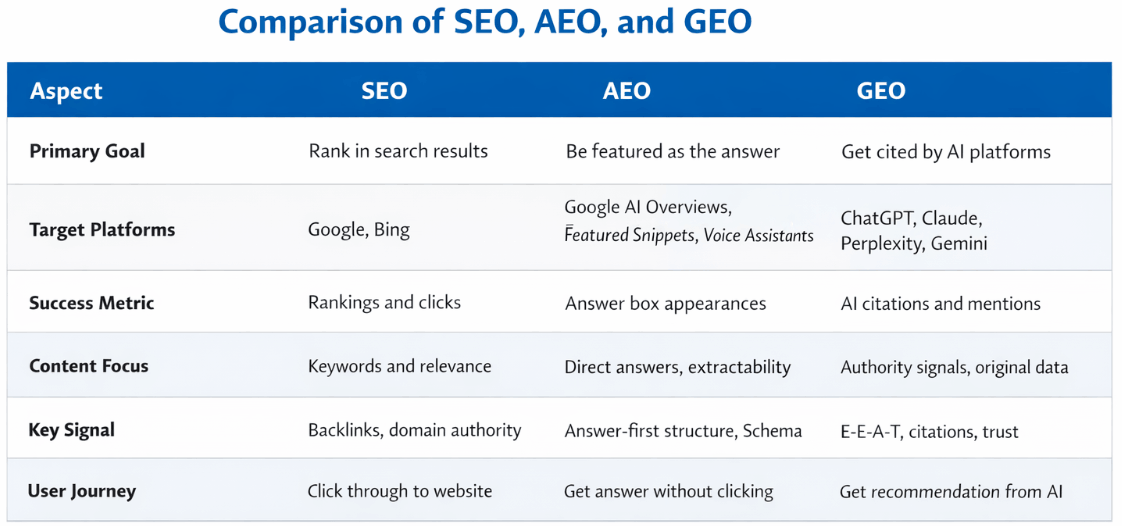
Understanding how traditional SEO, AEO, and GEO differ in goals, platforms, and tactics
Here’s why that matters. AI search traffic converts at 4.4x the rate of traditional organic visitors.
This guide shows you what I’ve learned testing these tactics. You’ll see which approaches actually moved the needle across different AI platforms. I’ll walk you through the exact process I used to go from zero citations to getting my content cited.
Reading time: 12 minutes
Understanding AEO and GEO
What is Answer Engine Optimization?
Answer Engine Optimization (AEO) helps answer engines give direct responses to user questions. Answer engines include Google AI Overviews, featured snippets, People Also Ask boxes, and voice tools like Siri and Alexa. These systems pull specific parts from your content and display them as the answer.
The goal is simple. Make your content easy for these systems to find and use. Traditional SEO gets you ranked in a list of links. AEO gets you shown as the answer itself.
What is Generative Engine Optimization?
Generative Engine Optimization (GEO) gets your brand cited by AI platforms when they create responses. These platforms include ChatGPT, Claude, Perplexity, and Google Gemini. Unlike answer engines that pull existing text, these AI tools combine information from many sources to create new responses.
Here’s the key difference. Answer engines pull exact quotes from one source. Generative AI combines many sources into new insights. Your strategy needs to cover both.
How Answer Engines and Generative AI Select Sources
AI systems use a method called Retrieval-Augmented Generation to build answers. When someone asks a question, the system finds specific passages from the web and combines them into a response. These engines act like lazy readers. They look for quick, clear information rather than reading entire pages.
Here’s what happens behind the scenes:
- The AI reads the query and identifies key concepts
- Finds relevant passages from content across the web
- Checks these passages for relevance, accuracy, and trust
- Combines the information into a clear answer
- lists sources that helped create the response
Large Language Models break content into data points they can compare. They don’t just match keywords. They understand meaning and intent. This lets them pull information from multiple sources into a single answer. Your content needs to be clear and well-structured, not just keyword-optimized.
The Three Factors That Determine Citations
AI platforms focus on sources that provide speed, clarity, and certainty. Research indicates that 97% of URLs cited in Google AI Overviews come from the top 20 organic search results, which means traditional SEO remains the foundation for AI visibility.
AI platforms check for consensus across multiple independent sources before deciding what to trust. If Reddit discussions, news sites, Wikipedia, and industry publications all say the same thing about a topic, AI treats that information as credible. This is why optimizing your own website alone isn’t enough. You need to show up on the platforms AI systems already trust and reference.
Accuracy matters more than vague claims. AI systems prioritize specific data points, statistics, and verifiable facts over general statements. They cross-check claims across sources, so if your content contradicts established information without strong supporting evidence, you won’t get cited. Be specific. Use numbers. Link to research.
Content needs to work when pulled out of context. AI systems extract individual passages, not entire articles, so each paragraph needs to stand alone and make sense by itself. If a paragraph only makes sense when you’ve read everything before it, AI platforms can’t use it effectively. This means front-loading key information and avoiding pronouns like “this” or “these” without clear referents.
What I Learned Testing AI Citations Across Platforms
I tested the same biotech SEO queries across ChatGPT, Claude, Perplexity, Gemini, and Copilot last year. The results showed something crucial: different platforms cited completely different sources for identical queries.
Perplexity and Copilot pulled different references when asked the same biotech SEO questions. ChatGPT picked certain sources while Claude ignored them entirely. Gemini favored yet another set of sources for identical queries. This means you can’t optimize for “AI” as one thing. Each platform has different ways of choosing sources, different trust signals, and different methods for pulling content.
Here’s what this means for your business. If your audience uses Microsoft tools at work, Copilot citations might matter more than ChatGPT. If your customers are researchers who use Perplexity for reviews, that platform deserves more attention. Test where your actual audience searches before deciding which platforms to optimize for. Don’t assume ChatGPT’s lead means it’s the only platform that matters for your industry.
The point is clear. You need to track how you show up across multiple platforms, not just one. What works for ChatGPT might not work for Perplexity. What Copilot finds might not appear in Claude or Gemini. Testing across platforms isn’t optional if you want full AI visibility.
Content Signals That Matter
Good results rely on E-E-A-T: Experience, Expertise, Authority, and Trust. AI platforms look for these signals when deciding which sources to cite:
- Original research and unique data
- Expert credentials and author attribution
- Fast load times under 2 seconds
- HTML-based text (most AI tools can’t read JavaScript)
- Mobile-friendly design
- Clean site structure with clear hierarchy
- Schema markup that identifies your content type
- Visible last updated dates
- Citations to credible sources
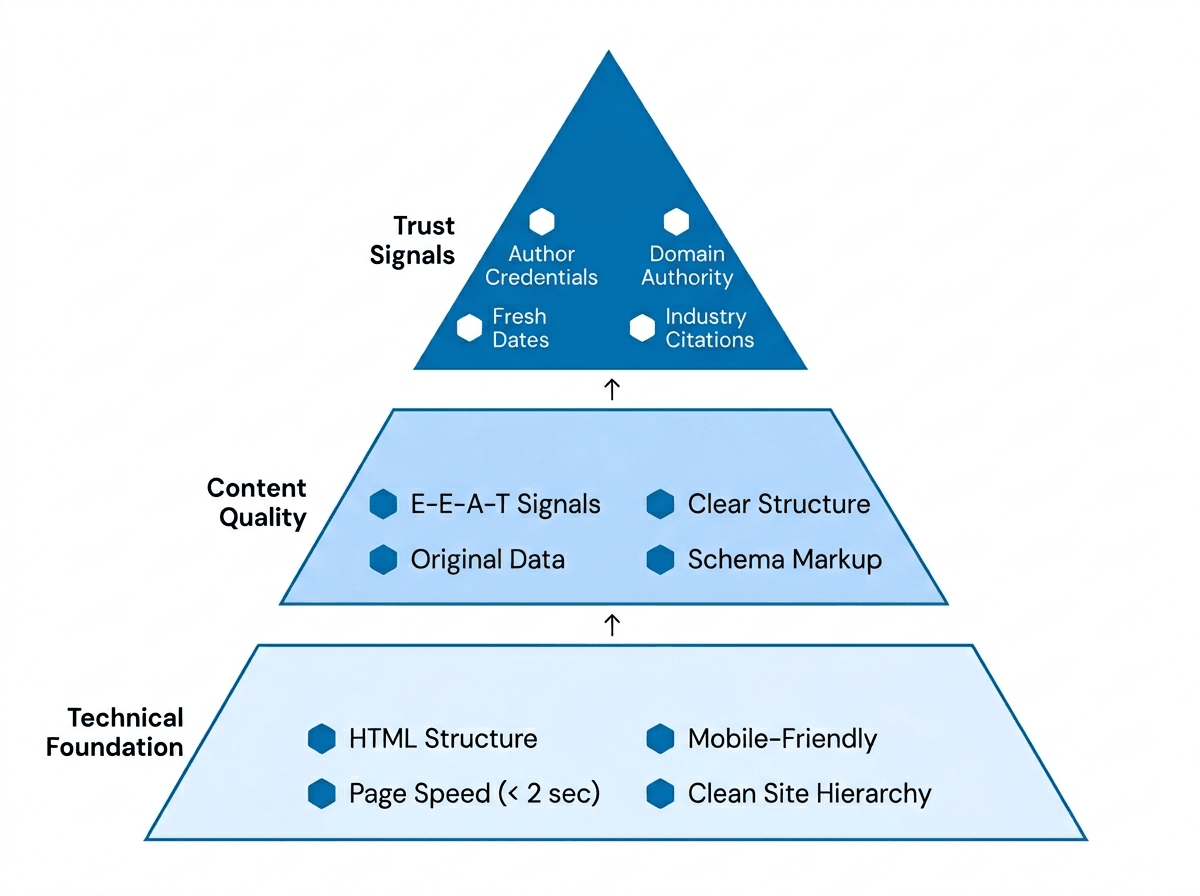
A visual hierarchy showing which AEO/GEO signals form the foundation vs. top-tier optimizations. Each layer builds on the one below it.
The Complete AEO/GEO Framework: 8 Best Practices
Practice #1: Answer First, Expand Later
Place a direct answer in the first 40 to 60 words of each section. This ensures AI can quickly identify your content’s value. Write your opening as if someone asked you the question directly. Answer it clearly, then add context and evidence.
This was one of the biggest changes I made. Before using the answer-first structure, Perplexity showed no results for my biotech SEO queries. After restructuring my top pages with direct answers in the first 50 words, Perplexity started citing my content for those same queries. The change showed up within a few weeks. Combined with schema markup, this became the foundation of my AEO results.
Practice #2: Use Structured Data and Schema Markup
Schema markup acts as your content’s digital ID card. Key types include Article schema for content pages, FAQPage for questions, HowTo for step-by-step guides, and Author schema with credentials. Google now limits FAQ rich results display to specific domains, but you should still add FAQ schema because it helps AI platforms understand your content.
I added FAQ schema across my site last year. Combined with the answer-first structure from Practice #1, this is when I started seeing citations appear. I tested both tactics separately before combining them. Answer-first structure alone showed minimal improvement. FAQ schema alone showed no change. The combination triggered visibility. This taught me that AEO requires multiple signals working together, not single tactics.
Here’s exactly how I added FAQ schema:
- Found my top 5 most-asked questions using AnswerThePublic and Google’s “People Also Ask” sections
- Wrote clear, direct answers in 40-60 words for each question
- Used Google’s Structured Data Markup Helper to create the JSON-LD code
- Added the code to my WordPress site using the WPCode plugin (free version works fine)
- Tested with Google Rich Results Test to ensure no errors
- Waited for search engines to recrawl and AI platforms to update their indexes
- Re-tested AI visibility across all five platforms
Practice #3: Create Conversational FAQ Sections
Use question-style headings that mirror natural language. “What is Answer Engine Optimization?” performs better than “Answer Engine Optimization Defined.” Match your headings to the exact questions your audience asks using tools like AnswerThePublic and People Also Ask sections.
Practice #4: Ensure Paragraphs Work in Isolation
Every paragraph should be a standalone unit. Avoid references like “as mentioned above.” AI systems pull individual paragraphs without surrounding text. Test by reading each paragraph on its own to ensure it provides clear value alone.
Practice #5: Include Original Insights and Data
AI models favor new information. Original surveys, case studies, and a unique dataset set you apart from competitors. Primary research, your own analysis, expert interviews, and industry-specific observations make your content worth citing.
Practice #6: Optimize Internal Linking
Use internal links to connect related topics. This helps AI understand your depth and authority on a subject. Use clear anchor text, link from strong pages to newer content, and create topic clusters with pillar pages.
Practice #7: Add Last Updated Dates
Display visible “Last Updated” timestamps. Research shows ChatGPT tends to cite newer studies before older ones when both are equally relevant. Regular updates with visible dates signal current information.
Practice #8: Implement Author Credibility Signals
Create a trust block near the top of each page with the author’s name and credentials, last updated date, cited sources, and a 40-50 word answer summary. This signals maintained, verified, credible content.
Here’s what I found testing this. When I ran my first AI visibility audit last year, Copilot cited my about page and LinkedIn profile for biotech SEO queries before any platform cited my blog content. Your author page gets cited before your expertise content does. This surprised me, but it makes sense. AI systems check who you are before they trust what you write.
What this means for you: if you’re a consultant, service provider, or anyone selling expertise, your about page or credentials page is more valuable for AI citations than your latest blog post. Spend time optimizing it first. Make sure it has a clear answer-first structure explaining who you are and what you do. Add schema markup for your credentials. Keep it updated. This page builds the foundation of trust that makes AI platforms willing to cite your other content.
Content Structure for AI Platforms
Platforms like ChatGPT and Google AI reward clear, structured content. According to Google VP Nick Fox, “Optimizing for AI search is the same as optimizing for traditional search.” The basics stay consistent, but execution requires more precision when you’re optimizing for AI platforms that extract and cite content differently than traditional search.
Here’s what works. Structure your pages with H1 to H3 headings that match the exact language people type into search tools. Your H1 should include your main keyword. H2s mark major sections. H3s break down the details. Keep paragraphs short, three to four sentences at most, and use tables when you’re comparing data or showing multiple options. The goal is to make information easy to extract, which means writing the way people actually ask questions rather than how you think content should sound.
Your content needs to be crawlable and indexable. The biggest mistake I see is hiding core text behind JavaScript. AI platforms can’t read JavaScript the way Google can. ChatGPT, Claude, and Perplexity need your content in clean HTML. Check your page source to confirm your actual text shows up there. Beyond that, make sure your site loads in under 2 seconds, works well on mobile, uses clean URLs, and includes valid schema markup. Fix any crawl errors showing in Google Search Console before they become bigger problems.
Watch out for these issues that kill AI visibility:
- Burying your answer under long introductions
- Inconsistent brand information across platforms
- Heavy JavaScript that makes content invisible to AI
- Random topics that dilute topical authority
- Missing schema markup
- Outdated content without a visible refresh date
AEO and GEO Tools and Resources
Free Tracking Options
You can track manually by creating a list of target keywords and questions. Search each in ChatGPT, Claude, Perplexity, Gemini, and Copilot. Log whether your brand gets mentioned. Track competitors. Monitor changes weekly or monthly. This takes time but it’s free and gives you the most useful data before you invest in paid tools.
For a quick baseline check, HubSpot’s AEO Grader scores how ChatGPT, Perplexity, and Gemini describe your brand. The free tool gives you a score out of 100, though it doesn’t show competitor data or specific citations. It’s useful for spotting whether you have a visibility problem, but manual tracking gives you the details you need to fix it.
Ahrefs Brand Radar offers a free tier for basic AI prompt tracking if you already use Ahrefs for traditional SEO. It lets you quickly check brand positioning across major AI models without paying for full platforms.
Small Business and Startup Tools
For teams just starting with AI visibility tracking, several affordable options exist. Otterly.ai offers a Lite plan at $29 per month for 15 search prompts, making it one of the most budget-friendly entry points. The Standard plan costs $189 per month and includes 100 prompts, with additional packs of 100 prompts available for $99 each.
AIclicks provides systematic tracking at $79 per month (or $59 annually), with promotional starter rates sometimes available. The platform tracks ChatGPT, Claude, Perplexity, Gemini, and Google AI Overviews with prompt-level tracking and competitor data. The base plan typically includes 30 tracked prompts across 3 select AI platforms.
Mid-Market Platforms
Semrush AI Visibility Toolkit is part of the Semrush One transition from late 2025. For teams on SEO Classic plans, the toolkit is a $99 per month add-on per domain. Semrush also offers unified Semrush One plans that bundle SEO and AI visibility, with the Starter plan beginning at $199 per month and including 50 tracked AI prompts. The toolkit tracks sentiment and narrative across ChatGPT, Gemini, Perplexity, and Claude, making it strong for teams that need deep brand intelligence alongside traditional SEO.
SE Ranking’s AI Search Toolkit tracks visibility across Google AI Overviews, Gemini, ChatGPT, and AI Mode with historical comparisons and Share of Voice metrics. The core platform pricing starts at $65 per month for Essential, $119 for Pro, and $259 for Business. Dedicated AI Search add-on packs cost an additional $71 to $89 per month, depending on the billing cycle. This makes it good for budget-conscious agencies that want integrated AEO and traditional SEO in one view.
Enterprise Solutions
Profound is the top choice for enterprise AEO at $499 or more per month, with custom pricing for larger setups. The platform combines SOC 2 compliance, GA4 links, multilingual tracking, and deep technical control. It’s built for enterprise teams that need dedicated support, real-time alerts, and connection with existing marketing tools.
Conductor offers the only full enterprise platform that combines AEO with traditional SEO work. Custom pricing typically reaches several thousand dollars per month. The platform connects AI visibility insights directly to content creation workflows and real-time site monitoring, making it good for organizations that need unified visibility tracking.
Your 30-Day AEO/GEO Implementation Roadmap
Implementation matters more than theory. Here’s a systematic approach to getting started with AEO.
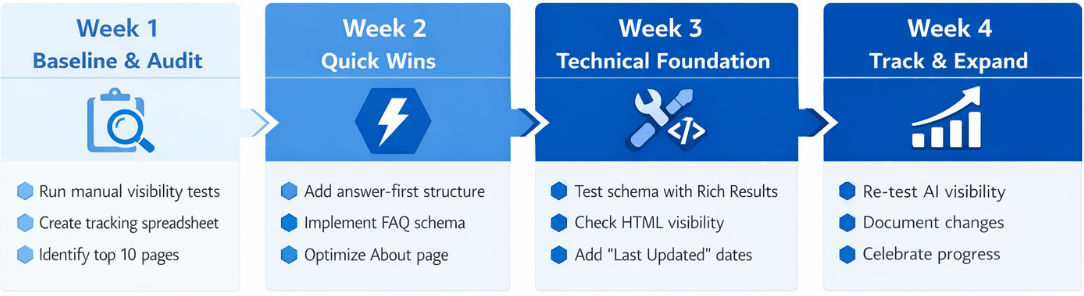
Week 1: Baseline & Audit
Run manual visibility tests across ChatGPT, Claude, Perplexity, Gemini, and Copilot for your top keywords. Document which platforms cite you (if any) and for which queries. Create a simple spreadsheet tracking platform, query, cited (yes/no), and competitors appearing. Identify your top 10 highest-value pages based on current traffic and conversion data.
Week 2: Quick Wins
Add an answer-first structure to your top 10 pages. Rewrite opening paragraphs to provide direct answers in the first 40-60 words. Implement the FAQ schema on those same pages using the process outlined in Practice #2. Optimize your About page or credentials page with a clear answer-first structure and Author schema. This is your foundation of trust.
Week 3: Technical Foundation
Test all schema implementations with Google Rich Results Test. Fix any errors that appear. Ensure your core content is in HTML, not hidden behind JavaScript. View the page source for each optimized page and confirm your text is visible in the raw HTML. Add visible “Last Updated” dates to all optimized pages. Make sure the dates are actually visible to users, not just in the page metadata.
Week 4: Track & Expand
Re-test AI visibility across all 5 platforms using the same queries from Week 1. Document any changes from baseline. Even small improvements (appearing in one platform’s results when you weren’t before) count as progress.
This systematic approach gives you a reproducible process rather than random optimization attempts. The combination of the answer-first structure and the FAQ schema working together is what triggered results for me.
When to Use AEO and GEO Services
Small businesses can handle most basic AEO work on their own. Start by updating your Google Business Profile and adding a FAQ page with schema markup. Make sure your content follows an answer-first structure and add basic schema types like Article, Organization, and Author. Build presence on platforms where your audience spends time, whether that’s Reddit, industry forums, or review sites. Keep your business name, address, and phone number the same everywhere you show up online.
Enterprise work is where professional services start to make sense. AI models update all the time, which means how they cite sources keeps changing. Watching brand sentiment across multiple platforms needs dedicated resources and specialized tools. Adding schema markup across hundreds of pages needs expertise that most internal teams don’t have. Tracking how you show up across ChatGPT, Claude, Perplexity, Gemini, and Copilot takes real time. Content work has to happen constantly, not just once.
Good professional services should check where you stand across platforms before suggesting fixes. They should focus on technical issues based on what matters most, not what’s easiest to fix. Content work needs to keep your brand voice while following AEO best practices. Regular tracking should show exactly where you’re being mentioned and how that changes over time. Building authority across platforms means getting a credible presence on the sites AI systems actually trust and use.
The business case is simple. Visitors from AI-powered search convert at 4.4x the rate of regular organic traffic because they show up already knowing about your solution. Professional services speed up results by doing fixes right the first time, finding big opportunities you might miss, tracking platforms every day, changing tactics as AI models evolve, and building authority in a planned way instead of randomly.
Conclusion
AI platforms are changing how people find information, and the shift is already happening. Answer engines and generative AI tools handle billions of queries every month. If your content isn’t structured for these systems, you’re invisible to a growing portion of your audience.
The framework I’ve outlined here works because it focuses on what actually moved the needle in my testing. Answer-first structure got me citations where I had none. The FAQ schema, combined with that structure, triggered visibility on Perplexity within weeks. Different platforms cited completely different sources for identical queries, which taught me that multi-platform tracking isn’t optional.
Start with manual tracking. Pick your top 10 pages. Test how they show up across ChatGPT, Claude, Perplexity, Gemini, and Copilot right now. Document what you find. Then apply answer-first structure and schema markup to those pages. Wait a few weeks and test again. The platforms update constantly, so what works today might need adjustments tomorrow, but the core principles stay consistent.
Most brands haven’t figured this out yet. Traditional SEO still gets the attention and the budget. That creates an opportunity for anyone willing to put in the work now. I’m still testing, still tracking, and still finding new patterns on how these platforms select sources. The data keeps changing, which means the strategy has to evolve with it.
Frequently Asked Questions
Should I hire an agency or do this myself?
Start with manual implementation if you have fewer than 50 pages and basic technical skills. The foundational work (answer-first structure, FAQ schema, author credentials) doesn’t require specialized expertise. Agencies make sense when you’re managing hundreds of pages, need technical schema implementation at scale, or want dedicated cross-platform monitoring that your team doesn’t have time for.
What if I have a small site with only 5 pages?
Small sites can still win AI citations. Focus on your homepage, about page, and top 3 service or product pages. Quality matters more than quantity. A well-optimized 5-page site with a strong answer-first structure and proper schema often gets cited before a poorly optimized 100-page site.
Can I use AI to generate AEO-optimized content?
AI tools can help with content structure and FAQ generation, but they often miss the original insights that get citations. Use AI to speed up formatting and schema markup, but make sure you’re adding unique data, real experience, or perspectives that don’t exist elsewhere. Generic AI-generated content rarely gets cited because it lacks the originality AI platforms prioritize.
Do I need to optimize for all 5 platforms or just one?
Different platforms cite different sources for identical queries. If your audience primarily uses one platform, start there. But most businesses benefit from multi-platform optimization because you can’t predict which platform your potential customers will use. Track where your audience actually searches, then prioritize those platforms first.
What’s the biggest mistake people make with AEO?
Treating it like traditional SEO. People optimize for keywords and rankings instead of optimizing for extraction and citation. The biggest shift is writing content that works when pulled out of context. Each paragraph needs to stand alone and provide clear value without needing the surrounding text.
Continue Learning About AEO and SEO
Keep exploring these strategies to improve your search visibility:
12 Proven SEO Writing Tips to Rank Higher on Google
Claude AI for SEO: The Tool That’s Redefining Search Success
Need Help With Your AEO/GEO Strategy?
I help science and technology companies get discovered in both traditional search engines and AI platforms. Combining molecular biology expertise with AI-powered content workflows, I create content that ranks and gets cited.
View My Services | Get in Touch

Curtis Haavi
SEO/AEO Specialist | Science & Technology
Curtis Haavi is an SEO content strategist specializing in AI, biotech, and emerging technologies. Combining molecular biology expertise with bioinformatics knowledge, Curtis helps research-driven companies create content that ranks and resonates.