
Last Updated on February 21, 2026
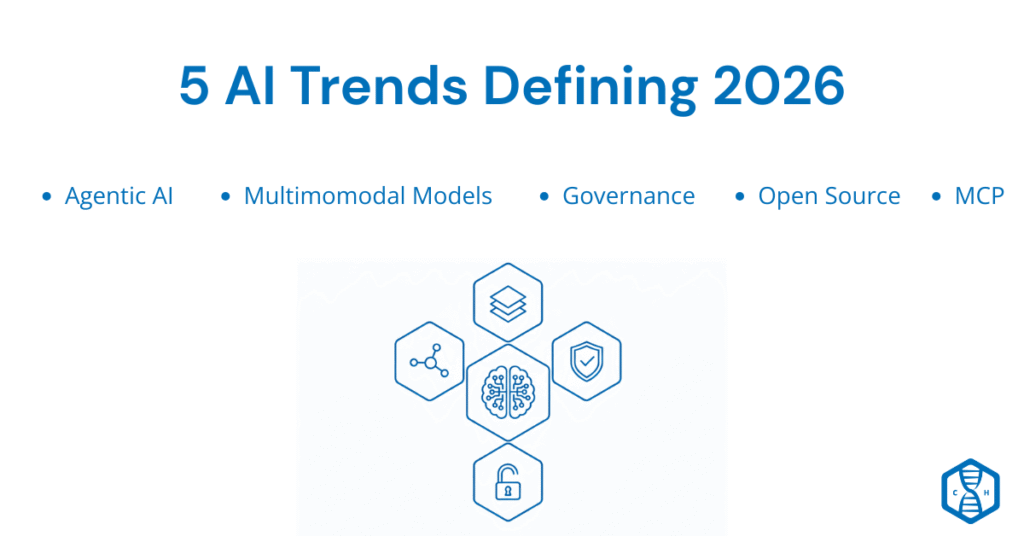
The five AI trends defining 2026 are agentic AI, multimodal generative AI, the Model Context Protocol, AI governance, and open source AI. After years of hype and experimentation, 2026 is when companies need to show real returns on their AI investments. The shift from demos to deployments is already underway.
The economics of AI have completely changed. What cost $100 million to train in 2023 now costs $5 million. Open source models match proprietary alternatives at a fraction of the cost. Smaller, specialized models outperform general-purpose systems on specific tasks.
Five major trends will separate leaders from those falling behind.
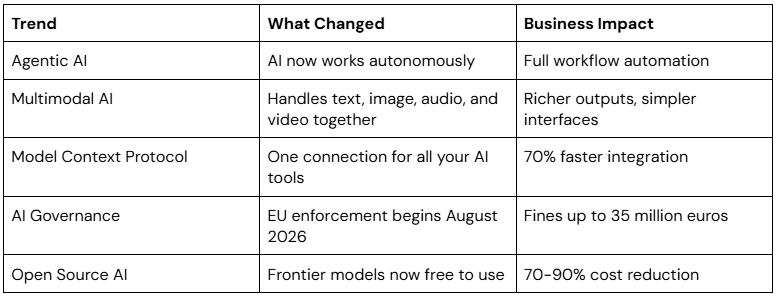
The 5 AI trends reshaping business in 2026 and what they mean for your organisation
Reading time: 14 minutes
1. Agentic AI: From Assistants to Autonomous Workers
Agentic AI systems autonomously plan, execute, and complete multi-step tasks without human input. Unlike traditional AI that waits for your command, agentic AI sets its own course. It breaks down complex tasks, figures out the steps needed, and carries them out on its own.
These systems handle complete workflows on their own. They organize international trips, adjust inventory based on real-time demand, and manage business operations without human control.
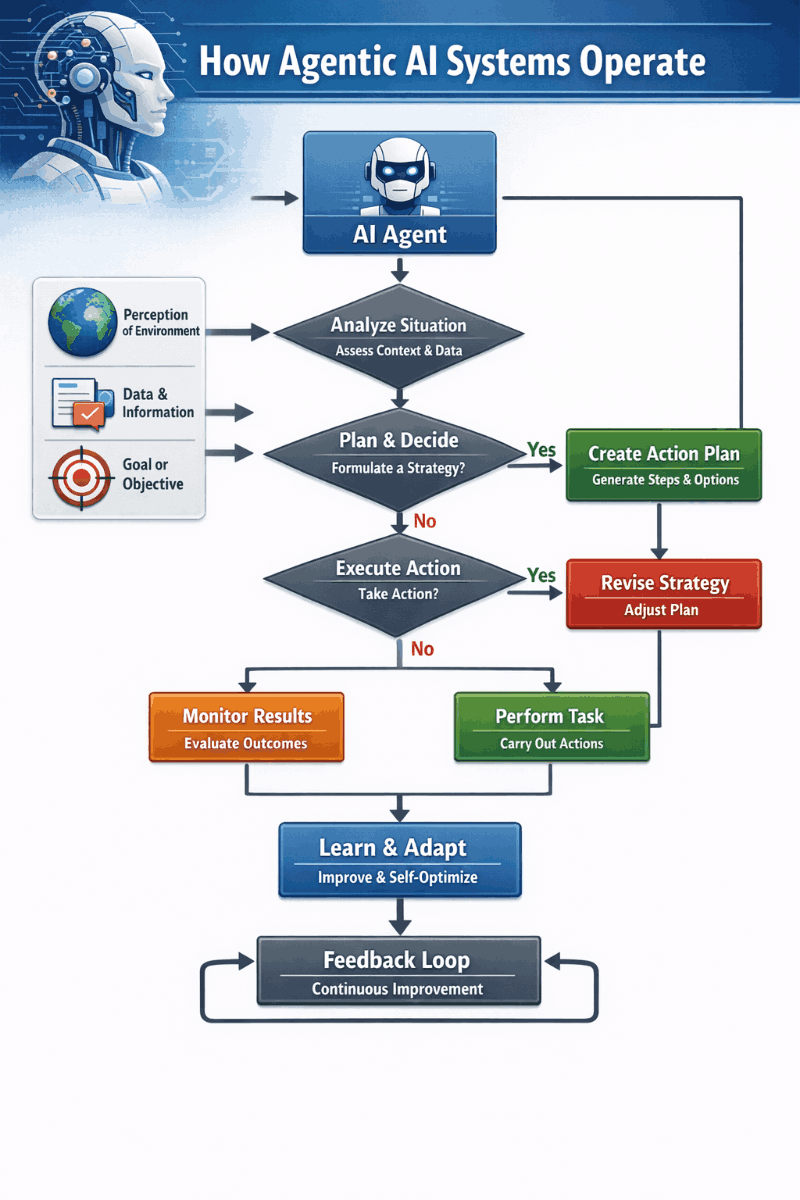
How agentic AI systems work: analyze, plan, execute, and learn
Real-World Uses
Business Automation
In October 2025, IBM partnered with Groq to deploy agentic AI across enterprise workflows, enabling organisations to move agents from pilot to production. These systems now handle complex tasks on their own, including HR processes and customer service, without constant human oversight.
Development and Coding
Anthropic released Claude Haiku 4.5 in October 2025, a model designed for multi-agent workflows. It matches the coding performance of Claude Sonnet 4 but runs twice as fast at one-third the cost. Organizations can now deploy teams of Haiku agents working together on different parts of a project at the same time, cutting development time and costs.
Healthcare Operations
In December 2025, AWS deployed agentic AI through Amazon Connect for healthcare providers, including UC San Diego Health. These systems manage patient scheduling, insurance verification, and appointment coordination, while handling 50% of total call volume without manual help.
Why Agentic AI Matters in 2026
Here’s the key shift. Organizations spent 2023-2024 trying out AI tools. Now they need AI that delivers real business value. Agentic systems do that by handling complete tasks, not just parts of them.
A 2025 McKinsey study showed that 78% of surveyed organizations use AI in at least one business function. The next phase? Moving from AI as a tool to AI as a team member that works on its own.
The technology is ready now. Reasoning models like OpenAI’s o1 and DeepSeek’s R1 can break down complex problems and carry out multi-step solutions. This makes true agentic action possible at scale.
Related: Exploring Agentic AI: Capabilities, Applications, and Future Trends
2. Multimodal Generative AI: The Next Evolution
Multimodal generative AI processes text, images, audio, and video simultaneously within a single model. Unlike early AI systems that only handled text, modern multimodal models like Google’s Gemini 3 let you upload a photo, ask questions about it, and get answers without switching tools.
Meta’s Llama 4 brought these abilities to open-source AI. It handles text and images at once. This enables visual search and better image descriptions. You can upload a photo, ask questions about it, and get answers without switching tools.
Real-World Uses
Healthcare
Google’s MedGemma and Microsoft’s MedImageInsight analyze X-rays, patient notes, and audio recordings at the same time. These systems merge radiology scans with written symptoms and doctor voice notes. This helps hospitals diagnose faster and more accurately.
Retail and E-commerce
Pinterest’s multimodal visual search lets customers upload product photos and add text descriptions at once. The system improved product recommendations by 30% in 2025. Shoppers now combine voice commands with images. They can say “find this in blue” while showing a photo of shoes.
Amazon and Google Shopping use this technology as well. Upload a furniture photo. Add the text “under $500 in oak”. The AI searches based on both the visual style and your budget.
Content Creation
Google released Veo 3.1 in October 2025. It creates video clips with synchronized audio from simple text prompts. Type “ocean waves at sunset with seagull sounds” and the AI creates a video with matching visuals and sound effects. No separate audio editing needed.
Filmmakers are already using it. Director Darren Aronofsky founded Primordial Soup, a studio that uses Veo to mix live-action footage with AI-generated scenes. This approach cuts production costs and speeds up the filmmaking process for independent creators.
Why Multimodal AI Matters in 2026
Using different data types creates better context. A text-only AI misses the frustration in someone’s voice. It can’t see confusion in a facial expression during a video call. Multimodal AI captures everything.
Making AI easier to use. You don’t need to learn complex commands. You can show images, type descriptions, or speak commands. The AI handles all three.
Related: Beginner’s Guide to Generative AI: Everything You Need to Know
3. Model Context Protocol: The System Revolution
The Model Context Protocol (MCP) is an open standard introduced by Anthropic in November 2024. It allows AI models to share context and access data across multiple platforms through a single connection, eliminating the need to build separate integrations for each AI tool you use.
Here is the problem it solves. Imagine your company uses five different AI tools. Your customer data sits in Salesforce, product information in Shopify, and support tickets in Zendesk. Each AI tool works alone, blind to the others. MCP connects everything.
What Is Model Context Protocol?
MCP is an open standard that links AI models to your data sources and tools. Think of it as creating a universal language for AI systems. Once you set it up, different AI platforms can access the same information without needing separate connections.
Traditional AI integrations work one-to-one. You build a custom link between ChatGPT and your CRM. Then you build another for Claude and your database. Another for Google’s AI. Each one takes weeks to develop.
MCP flips this to one-to-many. You build one MCP connection, and every compatible AI tool can use it. Connect your data once, and all your AI systems can access it safely.
The protocol includes three key components:
- Servers that expose data and tools
- Clients (AI applications) that consume them
- Resources (data sources like databases, files, APIs)
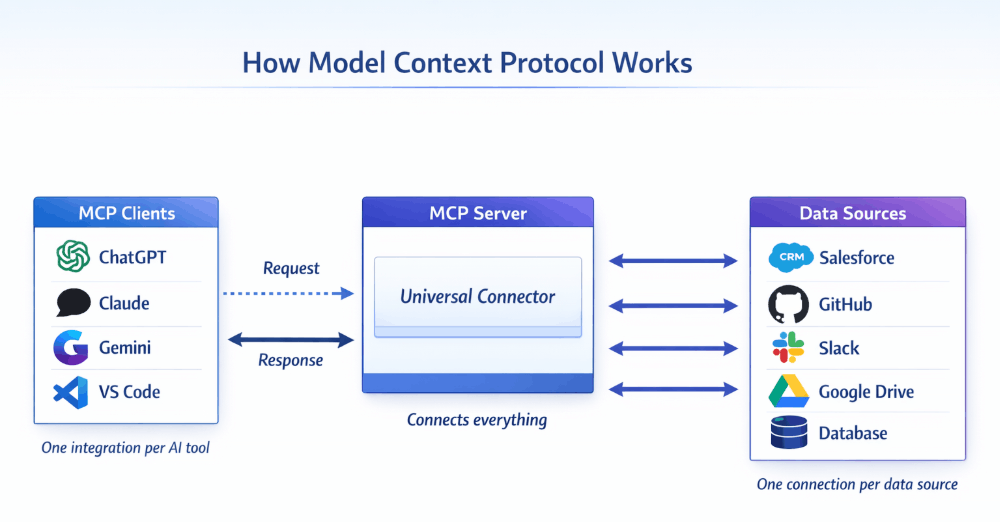
MCP creates a universal connector that eliminates the need for custom integrations between each AI tool and data source
Why MCP Matters for Businesses
Faster AI Setup
Most companies spend months building custom connections for each AI tool. MCP cuts that time by 70%. You connect your systems once and use them everywhere.
OpenAI adopted MCP across all its products in March 2025. They built it into ChatGPT Desktop, their Agents SDK, and Responses API. Now, developers working with OpenAI can tap into thousands of existing MCP connections without writing custom code.
Better AI Decisions
AI that can’t see your full context makes incomplete recommendations. MCP gives AI systems access to everything they need to make informed decisions.
A shipping company used MCP to connect its inventory system, shipping data, and customer orders. Their AI routing tool now considers all three data sources at once. Result: 23% reduction in delivery delays.
Lower Costs
Every custom integration costs developer time and maintenance. MCP reduces integration overhead by creating reusable connections.
Improved Security
Instead of giving each AI tool direct database access, MCP creates a controlled gateway. You set permissions once. Every AI tool follows the same security rules.
Real-World Uses
Enterprise Software Development
Block deployed MCP company-wide in early 2025. Thousands of employees now use their MCP-powered tool called Goose. It connects AI assistants with internal systems.
Development teams use MCP to refactor old code, migrate databases, and run unit tests. Design and support teams use it to write documents and handle tickets. The result: tasks that took hours now take minutes. Block reports 50-75% time savings and 25% more projects completed.
AI-Powered Development Tools
Zed faced a problem. Their developers needed to access resources across different systems. Switching between tools slowed them down.
Zed built an MCP server that connected everything. Developers saw results fast. Troubleshooting time dropped 30%. They could focus on coding instead of hunting for information.
Codeium did something similar. They integrated Google Maps through MCP. Now developers can ask “Find the distance between the office and the airport” without leaving their code editor. The AI uses the Google Maps API through MCP and returns the answer instantly.
Customer Service
In November 2025, Amazon Connect deployed MCP support for AI-powered customer service agents. These systems automatically look up order status, process refunds, and update customer records during self-service interactions without human intervention.
4. AI Governance: The Rules Take Effect
AI governance is no longer optional. 2026 brings enforcement with real penalties and real consequences across multiple regions, and the rules look different depending on where you operate.
Europe leads with the world’s most complete AI regulation. Bans on high-risk AI took effect in February 2025. Manipulative systems, predictive policing, and social scoring are all banned. August 2026 is the deadline that matters. That is when full requirements for high-risk AI systems kick in, covering biometric identification, critical infrastructure, education, employment, and law enforcement. Companies face fines of up to 35 million euros or 7% of global revenue.
The US followed a different path. President Trump’s December 2025 order blocked state AI regulations, sparking federal-state conflicts. States are moving forward anyway. They introduced over 1,080 AI bills in 2025, with 118 becoming law. American companies serving European customers need compliance programmes regardless.
The UK relies on guiding principles instead of dedicated AI laws. The AI Security Institute monitors advanced models for security threats while the government prepares legislation expected in late 2026.
China has established extensive requirements. Mandatory AI content labelling rules took effect in September 2025. Cybersecurity law amendments followed in January 2026.
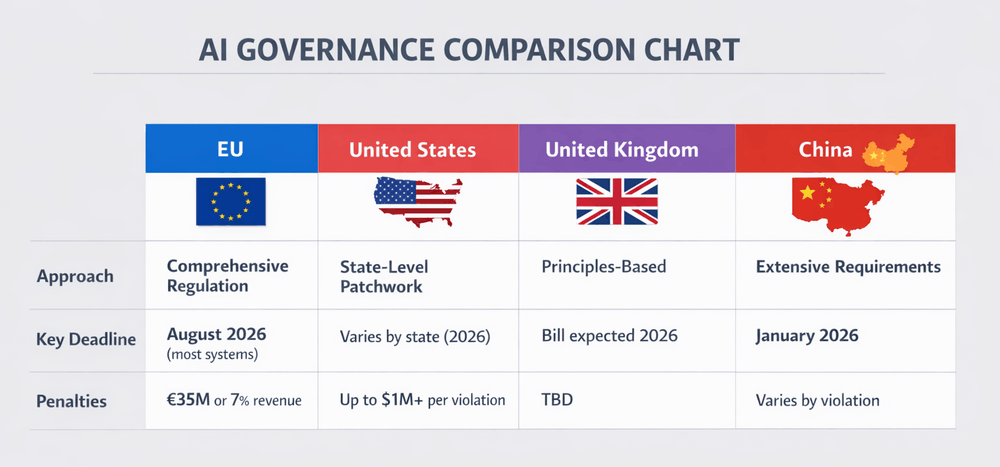
AI governance varies by region, from comprehensive EU rules to fragmented US state laws
What This Means for Your Business
The compliance burden is real but manageable.
Begin with an AI inventory to document every system and classify risk levels. You can’t govern what you don’t track. High-risk systems require detailed technical records covering training data, model design, testing methods, and risk reduction plans.
Beyond this, organisations must add copyright protections, strengthen data privacy controls, and train employees on AI fundamentals.
Fortune 1000 companies are creating new roles. Chief Data Officers and Chief AI Officers aren’t vanity titles. They’re business necessities.
McKinsey’s 2025 report reveals something striking. Companies where CEOs or boards oversee AI governance perform better financially. The link is clear. Good governance creates competitive advantage, not just compliance costs.
The best organizations treat AI governance as a strategy, not paperwork. They make AI work better in real operations.
IBM’s governance framework shows organizations succeed when they use strong governance. 2026 will see governance move from reactive compliance to proactive value creation. Companies with strong governance will outperform those treating it as an afterthought.
5. Open Source AI: The Great Equaliser
Open source AI models in 2026 deliver capabilities comparable to proprietary systems at 70-90% lower cost, with leading models now available for free commercial use. AI power is spreading. For years, the best AI models came from companies with billion-dollar budgets. Not anymore.
The December Breakthrough
On 2nd December 2025, French startup Mistral AI released its Mistral 3 family, 10 models ranging from 3 billion to 675 billion parameters. All open source. All free to use commercially under the Apache 2.0 licence.
The flagship model, Mistral Large 3, delivers capabilities that used to cost millions. Companies can now run cutting-edge AI on their own servers without using OpenAI’s or Google’s APIs.
Mistral wasn’t alone. Open source gained serious momentum in late 2025. Meta released Llama 4 in April 2025, with its massive Behemoth model still improving. Chinese labs released powerful models under open licences. Even NVIDIA announced plans for open models in early 2026.
The trend is clear: the gap between open and closed models is vanishing. What cost $100 million to train in 2023 now costs $5 million. What required 10,000 GPUs now runs on hundreds. The economics have fundamentally shifted.
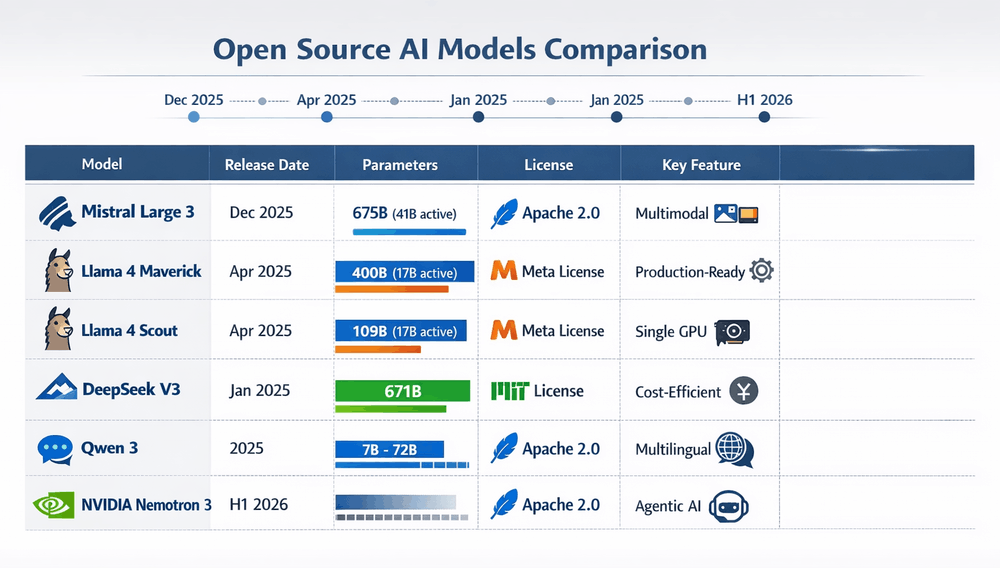
Leading open source AI models released in 2025-2026, demonstrating the rapid advancement of freely available frontier models
Why Open Source is Winning
The choice between open source and proprietary AI isn’t just about cost. It’s about control, customisation, and trust.
Open source models deliver three distinct advantages:
- Control. Use AI on your own servers and keep sensitive data in-house. No vendor can change terms or pricing. You own the systems completely.
- Customisation. Train models on your own data and optimise for specific needs. Financial services firms are fine-tuning models on decades of transaction data. Healthcare providers are building models that understand medical terminology.
- Cost. No licensing fees. No usage limits. Pay only for computer use and storage. For high-volume applications, this cuts costs by 70-90%.
The Competitive Landscape
Proprietary models still lead at the cutting edge, where OpenAI, Anthropic, and Google invest billions to stay ahead in complex reasoning. But history shows this advantage is temporary. Open source has a pattern of catching up: Linux matched Unix, Android overtook iOS in market share, and AI is following the same path.
Financial institutions are leading the adoption because data privacy rules prevent sending customer information to external servers.
Regulations accelerate this shift. Europe’s AI Act holds AI providers liable, which means using proprietary APIs creates shared legal risk. Running your own open source model gives you direct control over compliance and eliminates third-party liability risks.
Start with your constraints. Data sovereignty needs? Choose open source. Cutting-edge performance? Proprietary models lead slightly but cost more. For most uses, open source delivers similar results at lower cost.
The future isn’t open versus closed. It’s open source everywhere, with closed models holding a narrow band at the frontier, until open source catches up again.
The Future of AI in 2026
AI in 2026 isn’t about distant possibilities. It’s reshaping business right now.
Agentic AI is moving from assistance to autonomy. Generative AI now works across text, images, and video. Model Context Protocol is solving business connection challenges. Governance is shifting from voluntary to mandatory, with the EU AI Act taking effect in August. Open source models deliver frontier performance at lower costs.
Success won’t require the biggest budget. It requires smart decisions. Build governance frameworks now, before regulations force your hand. Test open source models while competitors pay premium prices. Use agents that automate work, not just assist with it.
AI is no longer optional for competitive businesses. These five trends will reshape every industry in 2026. Your next move matters more than your current position.
Want to discuss AI strategy for your industry? Connect with me on LinkedIn.
Frequently Asked Questions
Will AI replace my job in 2026?
Probably not entirely. AI works best at repetitive tasks but struggles with creativity, judgment, and human connection. Focus on developing skills AI can’t replicate: strategic thinking, emotional intelligence, and complex problem-solving. If most of your work involves screen-based routine tasks, consider upskilling now.
How much does AI cost for small businesses?
Less than you’d expect. Most small businesses spend £80-£400 monthly on AI tools. Basic automation starts around £4,000 for setup. Many businesses report savings that exceed their AI spending within the first year. Start with affordable, ready-made solutions before investing in custom systems.
Is open source AI good enough for business use?
Yes. Open source models like Mistral Large 3 now match proprietary alternatives while costing up to 90% less. Major organisations already use them in production. The main requirement is having tech skills to deploy and maintain them properly.
Continue Learning About AI
Explore these essential guides to deepen your AI knowledge:
Exploring Agentic AI: Capabilities, Applications, and Future Trends
Beginner’s Guide to Generative AI: Everything You Need to Know
How to Unlock AI’s Potential with Prompt Engineering

Curtis Haavi
SEO/AEO Specialist | Science & Technology
Curtis Haavi is an SEO content strategist specializing in AI, biotech, and emerging technologies. Combining molecular biology expertise with bioinformatics knowledge, Curtis helps research-driven companies create content that ranks and resonates.
Connect on LinkedIn | Email: connect@curtishaavi.com