
Last Updated on February 23, 2026
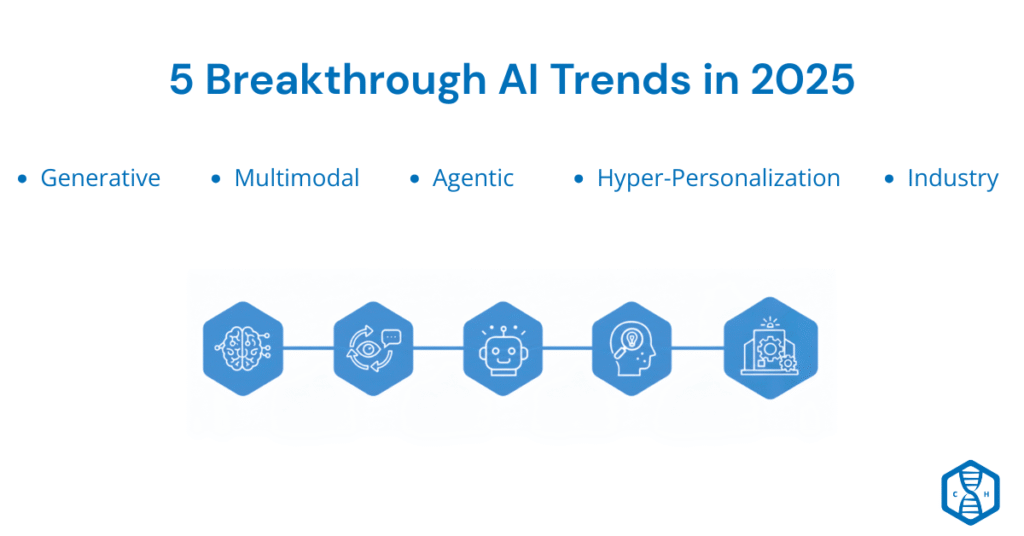
The 5 breakthrough AI trends you can’t ignore in 2025 are: generative AI, multimodal AI, agentic AI, hyper-personalization, and industry-specific AI applications in healthcare, finance, and software development. Artificial intelligence (AI) is driving innovation and changing industries at a record pace.
The rest of the year is set to be a major shift for AI. New trends will transform the way we live, work, and connect with the world. Whether you’re a business leader seeking to stay competitive, a tech enthusiast excited about cutting-edge breakthroughs, or simply curious about what’s next, keeping up with these trends is essential.
What You’ll Learn:
This guide covers the key AI innovations shaping 2025:
- How generative AI is transforming content creation and business operations
- The rise of multimodal AI systems that process text, images, and audio
- Agentic AI that makes independent decisions and takes action
- Hyper-personalization techniques driving customer experiences
- Industry-specific AI applications in healthcare, finance, and software development
Reading time: 11 minutes
1. Generative AI Technologies
Generative AI continues to lead the latest trends in 2025. Although it gained traction in early 2022, it remains relevant due to its use in multiple industries and easy access for the general public.
A 2025 McKinsey study showed that AI investment and adoption have surged in recent years, with investment doubling. Today, 78% of surveyed organizations use AI in at least one business function, with the biggest impact in IT, sales, marketing, and service departments.
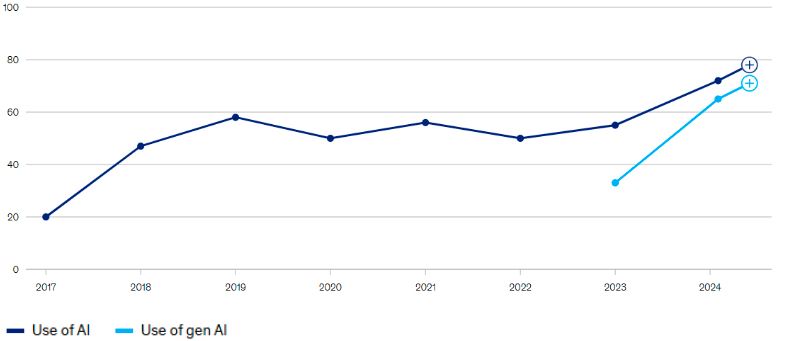
Growth in AI and Generative AI adoption from 2017 to 2024
Source: McKinsey
Latest Technology
Google has recently announced several new developments, including:
This is the new media model, capable of creating 30-second high-definition clips with improved physics. For the first time, it offers synced audio created on the fly from footsteps, ambient noise, and other elements of dialogue.
A model that focuses on still images, with a primary focus on precision. It’s able to capture textures like fabric, water droplets, and animal fur with impressive clarity.
Over recent years, China has become one of the leading tech industry leaders. This includes a lot of developments in generative AI:
A real-time image generator that can create images almost instantly as you type your commands. It gives you real-time images, no matter if you’re using text, voice, or even a quick sketch.
Alibaba’s latest video editing tool lets users create videos from a text prompt. Users can edit specific parts of a clip, such as changing the sky in one shot without affecting the rest. They can also combine multiple reference images and videos to control the final output’s appearance and movement.
How to Get Started with Generative AI
Start with a basic understanding of machine learning and deep learning. Explore online courses and projects to build an understanding of generative models.
Then, try out generative AI tools and platforms, focusing on specific areas where you see value.
Related: Beginner’s Guide to Generative AI: Everything You Need to Know
2. Multimodal AI
Picture an AI that goes beyond just reading text or identifying images. Imagine one that can read, write, see, hear, and create at the same time. This is the core of multimodal AI.
These advanced systems can handle and combine different data types, such as text, images, audio, and video. They give AI a complete range of sensory abilities. This amazing ability to both understand and create across multiple formats sets multimodal AI apart from earlier generative AI technologies.
Latest Technology
This is Meta’s latest multimodal development. It’s now beating leading competitors across multiple benchmarks. It can process both text and images at the same time, enabling applications like visual search, image captioning, and more.
Furthermore, it excels at matching user prompts with specific visual concepts within an image. This allows for more precise and relevant responses.
While it’s not as powerful and efficient as Llama 4, it remains a popular tool. It excels at blending different types of inputs during conversations, making interactions feel more natural and context-aware.
How to Get Started with Multimodal AI
Understand the basics of multimodal AI, then move on to try out free platforms like Google AI and Hugging Face to test your skills and build small projects. Once you have a clear goal, proceed to a model that best suits your needs.
3. Agentic AI
These are AI systems made up of independent agents that make decisions and take actions on their own to achieve specific goals. They often work with limited or no human oversight.
Imagine AI systems that can independently organize your next international trip and manage all travel bookings. Or consider AI-powered tools that instantly adjust inventory levels in response to real-time demand shifts. These are just a few examples of what’s possible with agentic AI.
It does this through complex reasoning and step-by-step planning models. These models solve complex multi-step problems on their own.
Latest Technology
A platform built to let researchers work with specialized agents. It drives scientific outcomes with scale, speed, and accuracy.
Built by CrowdStrike, it uses AI and machine learning to automate security operations. It improves operations within a Security Operations Center (SOC).
How to Get Started with Agentic AI
Begin by simulating with tools like OpenAI Gym or Unity ML-Agent. Try out reinforcement learning and simple agents.
Then create a basic chatbot or game-playing AI. This helps you grasp perception, decision-making, and action.
Doing this will give you hands-on experience. It helps you build a strong foundation in agentic AI.
Related: Exploring Agentic AI: Capabilities, Applications, and Future Trends
4. Hyper-Personalization
Have you ever wondered how streaming services know exactly what you want to watch or listen to? It’s all thanks to AI-driven customization, and it’s only getting better.
Companies are using AI, machine learning, and analytics to give customers an amazing experience. This leads to better profit margins.
Omnichannel Personalization
A way to provide a consistent and personalized experience across all customer touchpoints. This includes websites, mobile apps, social media, and in-store shopping.
AI uses data from many sources to create a smooth user experience. For example, beauty retailer Sephora uses a companion app. It helps customers find items based on past purchases and brands they tried in-store.
Talent Growth
Organizations are using AI-driven personalization in HR to grow talent. They customize training programs, career plans, and employee engagement strategies to meet each person’s needs. This helps ensure steady growth and development.
This approach has led to better employee retention and job satisfaction.
How to Get Started with Hyper-Personalization
Start simple by picking one part of your business where you want to use AI-driven personalization. Think about areas like customer emails or product recommendations.
Make sure you keep it clear. Let your customers know you are using their data to improve their experience.
5. Industry-Specific AI
The AI market has grown a lot since 2022, with more growth expected for 2025 and beyond. A recent Marketsandmarkets report predicts that the market will surge to $407 billion within the next three years. This represents a big jump from its $86.9 billion value in 2022.
Moreover, the AI industry is expected to maintain a strong annual growth rate of 37.3% from 2023 through 2030. AI has become the main driver of several fast-growing technologies and industries. This includes software development, healthcare, and finance.
AI in Software Development
The fast development of AI has led to the rise of “vibe coding.” Developers issue natural language prompts instead of writing traditional code. Not only can it create code from natural language prompts, but it can also review and test code. It finds both bugs and errors.
Latest Technology
Google introduced a new deep-think model that can create multiple solution paths before providing an output. This model stands at the front of the industry, beating similar models from OpenAI. This is due to its ability to handle complex solutions and strong coding abilities.
While it’s not as powerful as the latest Google release, it remains one of the most popular code-creating AI platforms. It now has over 1.3 million paid accounts across 50,000 companies. This is because it helps developers write cleaner, more efficient code by suggesting improvements and refactoring opportunities.
AI in Financial Services
AI is changing the finance industry as we speak. Research from Citigroup shows that AI could drive global banking industry profits to $2 trillion by 2028. Data from NVIDIA shows that data analytics is the largest area of interest.
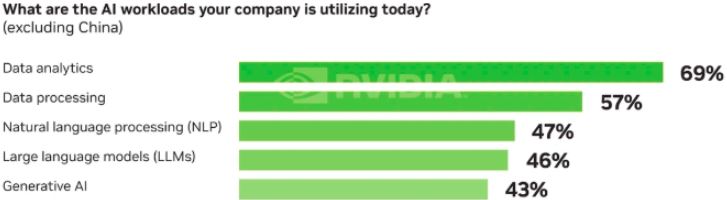
AI workload adoption by financial institutions, with data analytics leading at 69%
Source: NVIDIA
Latest Technology
A powerful, fast-growing data analysis tool used to simplify raw data into an easy format. It offers easy integration with databases and spreadsheets.
A Microsoft business analytics tool that offers dynamic visualizations and business intelligence features within a user-friendly interface. It allows users to create their reports and dashboards easily, improving interactive data exploration and insight gathering.
AI in Medicine and Healthcare
As time passes, AI is reshaping the job market. Goldman Sachs estimates that AI could do more than 25% of the work done by healthcare professionals.

Share of industry employment exposed to AI automation in the Euro Area, with healthcare at 25%
Source: Goldman Sachs
Personalized Medicine
An approach to healthcare that tailors medical decisions, practices, and products to individual patient traits. This includes genetic makeup, environment, and lifestyle. AI can be used to analyze data and tailor treatment towards a particular patient.
This technology has uses in the treatment of Alzheimer’s, obesity, and depressive disorders. Avenda Health has developed a new platform that uses the power of AI to deliver personalized therapies for prostate cancer.
Drug Development
AI can greatly reduce the time it takes for drugs to reach patients. This is due to its ability to process large amounts of data quickly. It works at a fraction of the time human researchers would need.
It can also identify potential targets that a drug can act upon. An example of this is Google’s and Isomorphic’s latest collaboration, AlphaFold3. A deep mind model is used to predict how molecules and proteins will interact.
AI in the Workplace
To succeed in the AI era, companies must use AI analytics to make critical insights widely accessible. This speeds up and improves their decision-making processes. By combining the data from work and people, AI helps businesses gain actionable insights. This makes them more agile and competitive.
One of the latest innovations in the market is AVEVA’s Industrial AI. It transforms how industries innovate and operate by using AVEVA’s Industrial Intelligence platform. This brings together models, clean data sets, and other key parts. It ensures AI is scalable, accessible, and able to deliver actionable insights with a fast return on investment (ROI).
How to Get Started
Individuals and businesses must stay ahead in this AI-driven landscape. This can be done by:
Step 1. Start Small
Don’t aim to change your entire operation all at once. Focus on one key area where AI can have the biggest effect.
Step 2. Analysis
AI provides valid data, but understanding the reasons behind it often needs human insight and judgment.
Step 3. Refine
Try out your AI tools, review the results, and adjust them as needed. AI isn’t something you can set up and ignore.
Step 4. Curiosity
The world of AI changes quickly. Therefore, it is key to explore and adapt to stay ahead of the curve.
Conclusion
These trends are not only driving technology innovation, but they’re also changing how we work, live, and connect. As AI advances, staying ahead means embracing these changes and addressing ethical challenges. It also means adapting to a future that is smarter and more personalized.
The AI revolution is here, and its potential is limitless for those ready to lead the charge. Continue exploring, stay curious, and start using these innovations today to stay ahead of the curve.
Frequently Asked Questions
Will AI replace humans?
No, AI is unlikely to replace humans altogether. While AI excels at tasks that require data processing, pattern recognition, and repetitive actions, it lacks human qualities. These include creativity, emotional intelligence, and complex problem-solving skills.
How will AI affect the job market?
AI has the potential to boost productivity and efficiency across industries. This will lead to the creation of new roles that require human intelligence, creativity, and emotional intelligence.
What is the best AI at the moment?
There is no fixed answer; the user’s requirements will determine the best AI.
What will AI look like in 10 years?
AI is expected to be much more integrated into daily life. It will impact many sectors, including healthcare, education, finance, and transportation.
Ready to Dive Deeper into AI?
Explore these essential guides to expand your AI knowledge:
Beginner’s Guide to Generative AI: Everything You Need to Know
Exploring Agentic AI: Capabilities, Applications, and Future Trends
The Content Creator’s Dilemma: Claude vs ChatGPT in 2025
How to Unlock AI’s Potential with Prompt Engineering
Claude AI for SEO: The Tool That’s Redefining Search Success
Need expert content on AI or science topics? [Let’s connect].

Curtis Haavi
SEO/AEO Specialist | Science & Technology
Curtis Haavi is an SEO content strategist specializing in AI, biotech, and emerging technologies. Combining molecular biology expertise with bioinformatics knowledge, Curtis helps research-driven companies create content that ranks and resonates.